


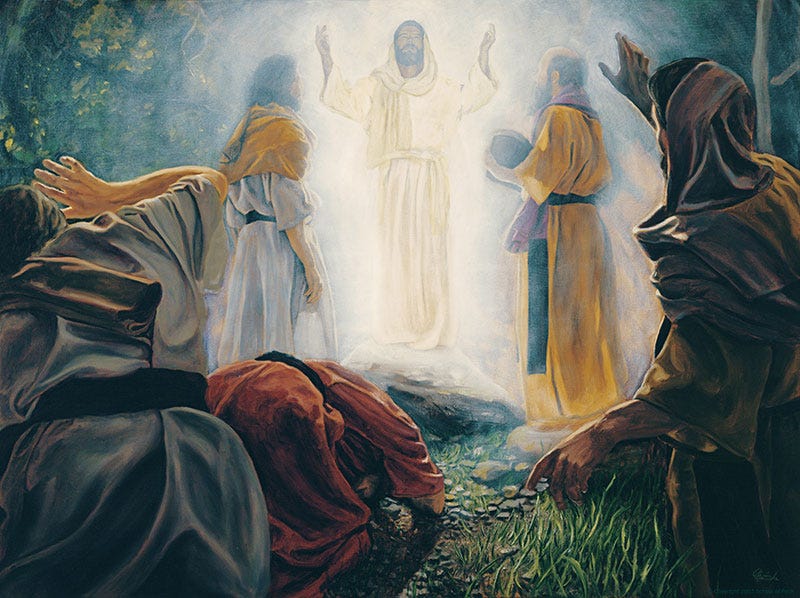
“After six days Jesus took with him Peter, James and John the brother of James, and led them up a high mountain by themselves. There he was transfigured before them. His face shone like the sun, and his clothes became as white as the light. Just then there appeared before them Moses and Elijah, talking with Jesus.
Peter said to Jesus, “Lord, it is good for us to be here. If you wish, I will put up three shelters — one for you, one for Moses and one for Elijah.”
While he was still speaking, a bright cloud covered them, and a voice from the cloud said, “This is my Son, whom I love; with him I am well pleased. Listen to him!”
When the disciples heard this, they fell facedown to the ground, terrified. But Jesus came and touched them. “Get up,” he said. “Don’t be afraid.” When they looked up, they saw no one except Jesus.” — Matthew 17:1–8
While He Was Still Speaking
I was reading through this passage last Sunday and noticed something I hadn’t before. Four words buried in the middle of the scene:
“While he was still speaking...”
GOD CUT HIM OFF.
He didn’t wait for Peter to finish. Didn’t hear him out. Didn’t say, “Interesting thought, let me build on that.” Peter was mid-sentence, mid-idea, mid-plan, and God simply talked over him.
Peter hadn’t said anything heretical. He’d said something reasonable. Even generous. Jesus had just been transfigured before their eyes. Moses and Elijah had appeared. And Peter, overwhelmed by the moment, offered to build three shelters. It was reverent. It was practical. He was volunteering his own labor.
And God cut him off before the last word left his mouth.
“This is my Son, whom I love. Listen to him.”
Not “build for him.” Not “plan for him.” Listen.
Ready, Fire, Aim.
Peter had a bias toward action. That’s what makes him one of the most compelling people in all of Scripture. He’s the one who jumps out of the boat. He’s the first to confess Jesus as the Christ. He’s the one who speaks up when everyone else is running the numbers on the loaves and fish.
But that same bias, that reflex to move before he listened, meant that Peter’s expectations were constantly dictating his response to what God was doing. And every time, his expectations were wrong.
Jesus tells the disciples he must suffer and die. Peter pulls him aside: “This shall never happen to you” (Matthew 16:22). He expected the Messiah to conquer, not to be crucified. His vision for how this was supposed to go didn’t include a cross. So when God revealed the plan, Peter didn’t listen. He rebuked the Son of God. And Jesus responded with one of the most jarring corrections in Scripture: “Get behind me, Satan” (Matthew 16:23).
In the upper room, Jesus kneels to wash the disciples’ feet. Peter refuses: “You shall never wash my feet” (John 13:8). He expected the order of the kingdom to flow downward. The disciples serve the master, not the other way around. He couldn’t fathom the king kneeling. So instead of asking, “Lord, why are you doing this?” he just said no.
When Jesus walked on the water, Peter was the only one bold enough to step out of the boat. That took real faith. But the moment his eyes shifted from Jesus to the wind and waves, he sank (Matthew 14:28–31). He expected his boldness alone would be enough. It wasn’t. Only focus on Jesus could sustain what boldness had started.
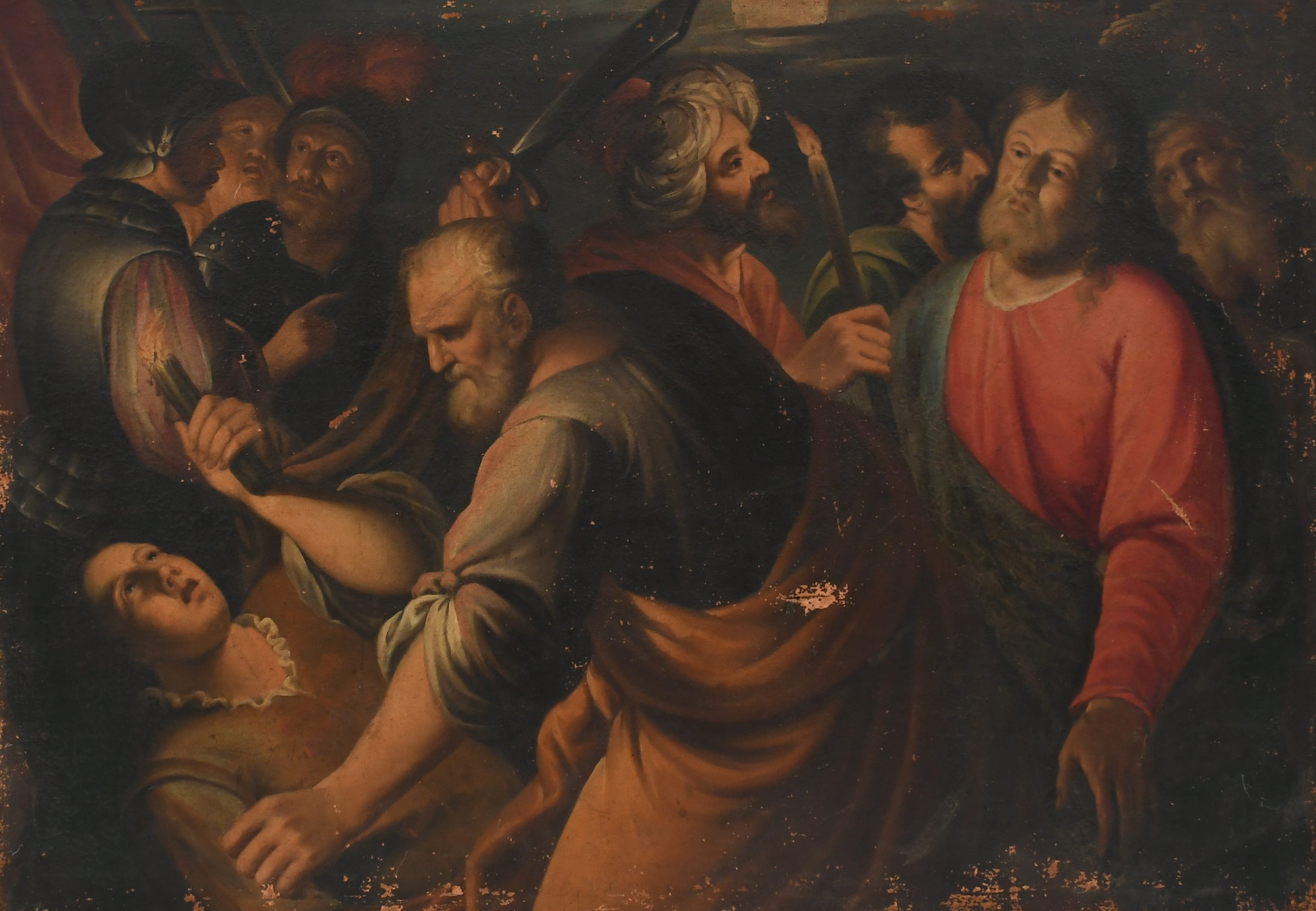
In the garden, soldiers came for Jesus, and Peter drew his sword and cut off a man’s ear (John 18:10). He expected this was the moment to fight, that he was helping God’s plan. But Jesus was surrendering, and Peter was swinging. He was playing the wrong game entirely.
And that same night, three times he was asked if he knew Jesus. Three times he denied him (Luke 22:54–62). He never expected he was capable of betrayal. But he was.
Every one of these moments shares the same root: Peter had already decided how things were supposed to go, and when reality didn’t match his expectations, he reacted instead of listened.
Fix it. Stop it. Fight them. Deny it. Ready, fire, aim. Every single time.
Feed My Sheep
After the resurrection, Jesus finds Peter on the shore and asks him three times: “Do you love me?” Three times Peter says yes. Three times Jesus responds: “Feed my lambs. Tend my sheep. Feed my sheep” (John 21:15–17).
Three questions for three denials. But this isn’t just restoration. It’s re-orientation. Jesus is redefining what Peter’s bias toward action is supposed to look like.
It’s not storming the temple. It’s not cutting off ears. It’s not fighting Romans. It’s not the weak serving the strong like the washing of feet. It’s feeding sheep. It’s humility. It’s caring for the least of these.
Jesus had been saying this his entire ministry: “The Son of Man did not come to be served, but to serve” (Matthew 20:28). Peter heard it, but he hadn’t absorbed it. Not until the beach. That conversation redefines “good action.” The bias toward movement is exactly what God wants. But what counts as good needs to be redefined according to God’s vision, not Peter’s.
Running Christ’s Playbook
You can see the fruit of this at Pentecost. Peter stands before thousands and preaches. And he’s still the one who steps up. Still the one taking the shot. The fire hasn’t gone anywhere. But listen to what he says.
The man who once rebuked Jesus for saying he would die now stands in front of a crowd and declares that the cross was “the definite plan and foreknowledge of God” (Acts 2:23). Peter, who couldn’t stomach the idea of a suffering Messiah, now proclaims that the suffering was the plan, and the plan was good. He’s submitted himself to how God wanted this to happen, even though it was the hardest thing he ever had to accept.
And when the crowd is cut to the heart and asks, “What shall we do?” (Acts 2:37), imagine what the old Peter might have said. Revolt. Fight. Take up swords. Storm the temple.
Instead, Peter says: “Repent and be baptized every one of you in the name of Jesus Christ for the forgiveness of your sins” (Acts 2:38). Ask for forgiveness. Follow Christ. Do what he told us to do. Peter isn’t running his own playbook anymore. He’s running Christ’s. And the fruit is three thousand souls.
While He Was Still Speaking... Again
But the moment that stopped me cold, the one that ties this whole arc together, comes later in Acts 10.
Peter is on a rooftop praying when God sends a vision: a sheet lowered from heaven full of unclean animals, and a voice telling him to eat. Peter’s first response sounds exactly like the old Peter: “By no means, Lord; for I have never eaten anything that is common or unclean” (Acts 10:14). Same reflex. Same instinct to tell God how things are supposed to work.
But this time, something different happens. The vision comes three times, and Peter doesn’t escalate. He doesn’t double down. He doesn’t overcorrect. He falls silent.
Luke tells us Peter was “inwardly perplexed” (Acts 10:17). Thoroughly puzzled. Wrestling with the fact that this was not how it was supposed to go. Which is exactly how he felt every other time God disrupted his expectations. But this time, instead of reacting, instead of fixing, stopping, fighting, or denying, Peter does nothing. Luke uses a specific word in verse 19: Peter was “pondering” the vision. The Greek word means to think through carefully, to turn something over in the mind. Peter is thinking before acting. For anyone who has watched him operate through the Gospels, this is a seismic shift. He waits for the Spirit to clarify.
Listen to him. God said it on the mountain. And Peter is finally doing it.
When the Spirit tells him to go with Cornelius’s men, Peter obeys without fully understanding why (Acts 10:20–23). That’s called faith. He arrives at Cornelius’s house, and he doesn’t perform. He doesn’t grandstand. He asks questions. And then he does something the old Peter never would have done. He listens.
Cornelius tells Peter everything: the vision, the angel, the instructions to send for Peter. And then he says something remarkable: “Now therefore we are all here in the presence of God to hear all that you have been commanded by the Lord” (Acts 10:33). Here is a Roman centurion, a Gentile, someone entirely outside the world Peter grew up in, telling Peter that God is at work and they are ready to hear what God has to say. Peter is hearing an affirmation of God’s plan from the last person he ever expected to deliver it. And he’s hearing it because he stayed long enough to listen.
Only then does Peter speak. And listen to what comes out: “Truly I understand that God shows no partiality” (Acts 10:34).
Truly I understand. What he was inwardly perplexed about, what made no sense, what violated everything he thought he knew, he now understands. Because he waited. Because he listened. Because he let God clarify instead of forcing his own conclusion. “God has shown me that I should not call any person common or unclean” (Acts 10:28). Not “I figured out.” Not “I decided.” God showed, and Peter followed.
It’s Peter’s action. But it’s not Peter’s way. It’s God’s.
And then comes the moment that wrecked me.
Peter is preaching to Cornelius and his household, and Acts 10:44 says: “While Peter was still saying these things, the Holy Spirit fell on all who heard the word.”
While he was still speaking.
The same phrase. The exact same construction as the mountaintop. But this time, God doesn’t cut him off to say, “Be quiet and listen.” This time, the Holy Spirit falls on everyone in the room. God doesn’t interrupt Peter. He affirms him. He pushes the gospel forward through Peter’s words.
On the mountain, “while he was still speaking” was a rebuke. Peter was ahead of God, building where God hadn’t asked him to build. At Cornelius’s house, “while he was still speaking” is a confirmation. Peter is aligned with God, and God meets him in the middle of his sentence with power instead of correction.
Same man. Same fire. Same boldness. But now he’s aiming.
A Blueprint for Zeal
God never rebuked Peter for his courage. He never told him to stop acting, stop leading, stop being the one who steps up. He built his church on Peter, called him the rock, because that fire was exactly what the mission required.
But Peter had to learn that fire without listening is just a man swinging a sword in the dark. He had to be re-oriented. Not away from action, but toward the right kind. The humble kind. The kind that feeds sheep instead of cutting off ears. The kind that says “repent and be baptized” instead of “grab your swords.” The kind that sits with confusion long enough to hear God say something you never expected.
Peter’s story isn’t a warning against zealous action. It’s a blueprint for how to do it God’s way. Act, but in obedience. Move, but in service of God’s plans, not yours. Keep your finger on the trigger, but wait long enough to hear from God before you fire. And when you do, you might just find that instead of cutting you off, the Spirit falls on every word.
-JW
About the Author:
Currently, I serve as the Executive Director of Them Before Us, advocating globally for the rights and well-being of children.
I am also the co-founder of All The Good, a leadership organization helping non-profits do all the good they are called to do.
I studied Cross-Cultural Ministry and Humanitarian and Disaster Leadership at Messiah and Wheaton. I read a lot and sleep less than I probably should.
My wife and I live in Charlotte, North Carolina with our 4 kids.

What a brilliant portrait of Peter, and a mirror to our own souls. It takes a great talent to notice and summarize it like this. Thank you!