

What Charlotte won't say about Upward Mobility.

Last year, it was announced that Charlotte has climbed from 50th to 38th in economic mobility since Raj Chetty’s devastating 2014 study ranked us dead last among America’s largest cities for upward mobility. Twelve spots in eleven years is real progress, and it didn't happen by accident.
Much of that progress belongs to Leading on Opportunity, the organization created in the wake of the Task Force to carry its recommendations forward. LOO brought structure and alignment to the work of countless nonprofits, churches, and community leaders who had been mobilizing since the Chetty study hit. Foundation For The Carolinas, the LOO team, and Charlotte's generous neighbors deserve real credit for what's been built. In 2022, LOO launched the Opportunity Compass, a data visualization tool designed to measure and align the city's collective efforts around shared goals in real time. It started with 33 indicators. Today it tracks 82.
But when you create a measurement tool this comprehensive, every indicator you track (and every one you don’t) tells a story.
What’s Missing?
When the Leading on Opportunity team announced last Fall that they had updated the Compass with several new indicators, I jumped on the site to scroll through. Four of the five main determinants are improving or stable. But one continues to decline: Child & Family Stability.
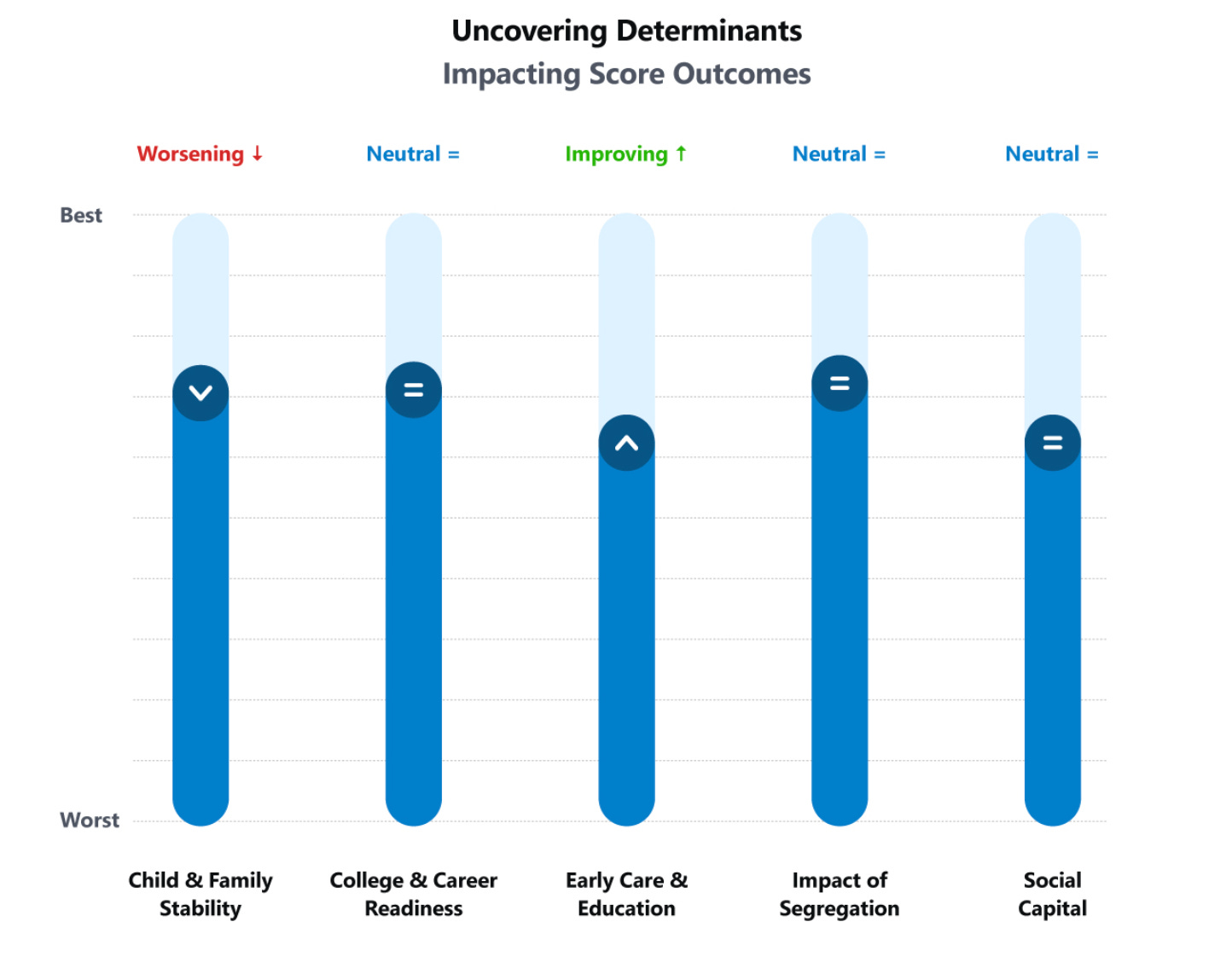
That stuck out to me. So I dug into the category. Child & Family Stability contains 26 indicators organized into four drivers: Health & Wellbeing, Family Formation, Financial & Housing Prosperity, and Safe & Stable Homes. Most of the indicators seemed reasonable: teen pregnancy, child abuse and neglect, incarceration rates, evictions, housing instability, infant mortality, drug overdoses. Good things to track. They even include some things I would consider less critical: proximity to parks and adults with high blood pressure.
But as I scrolled through all 26, I noticed something was missing. No marriage rates. No divorce trends. No tracking of father presence. Out of the 26 indicators in the determinant most connected to family structure, not a single one mentioned marriage or fathers.
What the Research Shows:
The missing indicators nagged at me. If the Compass wasn’t tracking marriage or father presence, maybe there was a reason, maybe the research didn’t support it. So I went back to the original studies and reports that preceded our Compass to find out.
What I found was the opposite. Family structure isn’t just relevant to Child & Family Stability, it may be the single most important factor in upward mobility, period.
The original paper “Where is the Land of Opportunity?” (that ranked us last) authored by Raj Chetty and others didn't bury this: "The fraction of children living in single-parent households is the single strongest correlate of upward income mobility among all the variables we explored." Not one of many. The strongest. Charlotte's own Task Force paraphrased this in their work: "Chetty and his colleagues identified five correlating factors that are the strongest predictors of upward mobility… Of these, family structure was found to be the most predictive of economic mobility."
The depth of data backing this assertion is striking. Brookings scholar Richard Reeves found: “Four out of five children who started out at the bottom income quintile but who were raised by parents married throughout their childhood, rose out of the bottom quintile as adults. In contrast, children raised in the bottom quintile by a parent who remained unmarried throughout their childhood had a 50 percent chance of remaining there.”
Same starting point. Dramatically different odds (80% vs 50%).
The pattern was clear. The indicators our Compass was measuring as declining: incarceration, evictions, teen pregnancy, child abuse and neglect, weren't independent problems. They were symptoms pointing to a common root: a family structure issue. More specifically, a marriage issue.
The Evolution
So now I’m sitting with a question: Did Charlotte ever get this right? Did we always overlook family structure, or did something change along the way? I went back to the beginning, to the 2017 Opportunity Task Force Report, the document that ultimately led to the creation of Leading on Opportunity and the Compass itself. If our current tools weren’t measuring what the research said mattered most, maybe the original report had.
It had. The Task Force, after consulting with a notably diverse array of researchers from Harvard, Brookings, the American Enterprise Institute, Pew, and the Manhattan Institute, spoke with remarkable specificity:
“Family structure was found to be the most predictive of economic mobility...”
“Statistics show that children receive substantial long-term benefits and opportunities when raised in a two-parent household, even more so when a couple is married.”
“Promote marriage, which research shows is the most reliable route to mobility…”
“Advocate for the active involvement of fathers in the lives of their children.”
The Task Force even specified how to promote and track this:
“Develop culturally appropriate communications and data-rich messaging strategies to increase awareness of the value of marriage, committed relationships, and co-parenting…”
Measure “Relationship status of parents at the time of birth” a single metric capturing biological parentage, marital status, and father involvement.
Today, though, the Compass only describes family this way:
“Though families come in all shapes and sizes, the presence of two (or more) loving and caring adults in a child’s home-life offers more opportunities for learning, bonding, and the development of healthy social skills.”

Both statements contain some truth. The 2025 language (we can all see) is trying to be more “inclusive” of diverse family experiences—I do understand the intent. But when you’re talking about a data-driven tool and are trying to measure what actually moves the needle for children in poverty, specificity matters. Two (or three) parent homes do not have the same impact on mobility that growing up with a married mother and father.
The research relied upon in 2017 by the original team hasn’t become less true in the intervening decade. But somehow our city’s measurement language became much less specific. And when the Child & Family Stability determinant is declining while others improve, it makes me wonder if that trade off, specificity for inclusion, came with a cost—specifically for kids.
In all, out of the Compass’ 82 indicators, family structure appears exactly once, a metric called “Two-Parent Homes” that makes no distinction between married and cohabiting parents, biological fathers and stepfathers, or stable households and temporary arrangements.
The Compass dedicates more indicators to library card participation and proximity to parks than to whether children have access to their married mother and father.
The Opportunity
If we believe Family Structure is the most predictive factor, we need to measure it with the same specificity we apply to housing, education, and healthcare. The original Task Force already identified potential metrics, including relationship status of parents at the time of birth. I'd add marriage and divorce rates and father presence in the household as additional indicators that would strengthen the tool. Adding them now wouldn’t need to replace anything, it would instead complete the picture and align the Compass with the research Charlotte paid for and cited extensively in 2017.
The 2017 Task Force admitted “This topic was one of the most challenging issues we tackled. Some members strongly advocated that we take a firm stand on “marriage for all” as a value to uphold. Others recognized that changing trends in family structure are unlikely to reverse and cultural realities can make marriage less attractive.” Some members advocated for strong marriage promotion. Others recognized changing trends.
But in the end, they let the data guide them: “Promote marriage, which research shows is the most reliable route to mobility, recognizing it may not be the choice of all couples.”
That willingness to follow research wherever it led, even knowing it would be controversial, even after internal disagreement, distinguished Charlotte’s response.
When Chetty’s study ranked us last, many cities dismissed the findings or made excuses. Charlotte took the data seriously. We consulted the best researchers we could find, asked hard questions, and made evidence-based recommendations.
And it worked. That progress came from Charlotte’s commitment to measuring what matters, not just what’s comfortable.
The Stakes
If you’re a teenager in Charlotte making decisions about when to have children, who to marry, and what to do to ensure your children have a better life than your own, you deserve to know what research shows. More importantly, if you’re a teacher, counselor, nonprofit leader, or policymaker working with that teenager, you deserve measurement tools that point toward what actually works.
A compass should point north, specific and unwavering regardless of the challenges we face taking that path. North doesn't move because the journey is hard. And clarity isn't condemning. It's kind.
I spent most of my career working in Charlotte’s most vulnerable communities, through nonprofits and churches. I now advocate for children’s rights as the Executive Director of Them Before Us. I support early education, healthcare access, housing stability, and safety nets. Our progress on these fronts deserve praise.
But our continued progress will require honesty about all the indicators that matter. Family structure isn’t the only factor in economic mobility. But it’s consistently identified as the most impactful one. Measuring everything else while omitting this isn’t just incomplete, it makes solving the declining Child & Family Stability determinant nearly impossible.
You cannot solve a problem you refuse to define clearly.
Charlotte has done this before. The 2017 Task Force proved we can follow data wherever it leads. The families navigating poverty deserve measurement tools built on that true foundation.
They deserve a compass that points North.
About the Author:
Currently, I serve as the Executive Director of Them Before Us, advocating globally for the rights and well-being of children.
I am also the co-founder of All The Good, a leadership organization helping non-profits do all the good they are called to do.
I studied Cross-Cultural Ministry and Humanitarian and Disaster Leadership at Messiah and Wheaton. I read a lot and sleep less than I probably should.
My wife and I live in Charlotte, North Carolina with our 4 kids.
