


If you have spent any time on social media these past few weeks, you’ve probably heard about the protests in France. For weeks the marches were peaceful. They began in September with high school students blockading their schools over class sizes, and grew into something national, hundreds of thousands in the street. Then, on the weekend of October 17, the chaos broke out, as it so often does there. And it has not stopped. Yesterday was the third straight weekend, with hundreds of thousands in the street again and tear gas in Paris and Lyon.
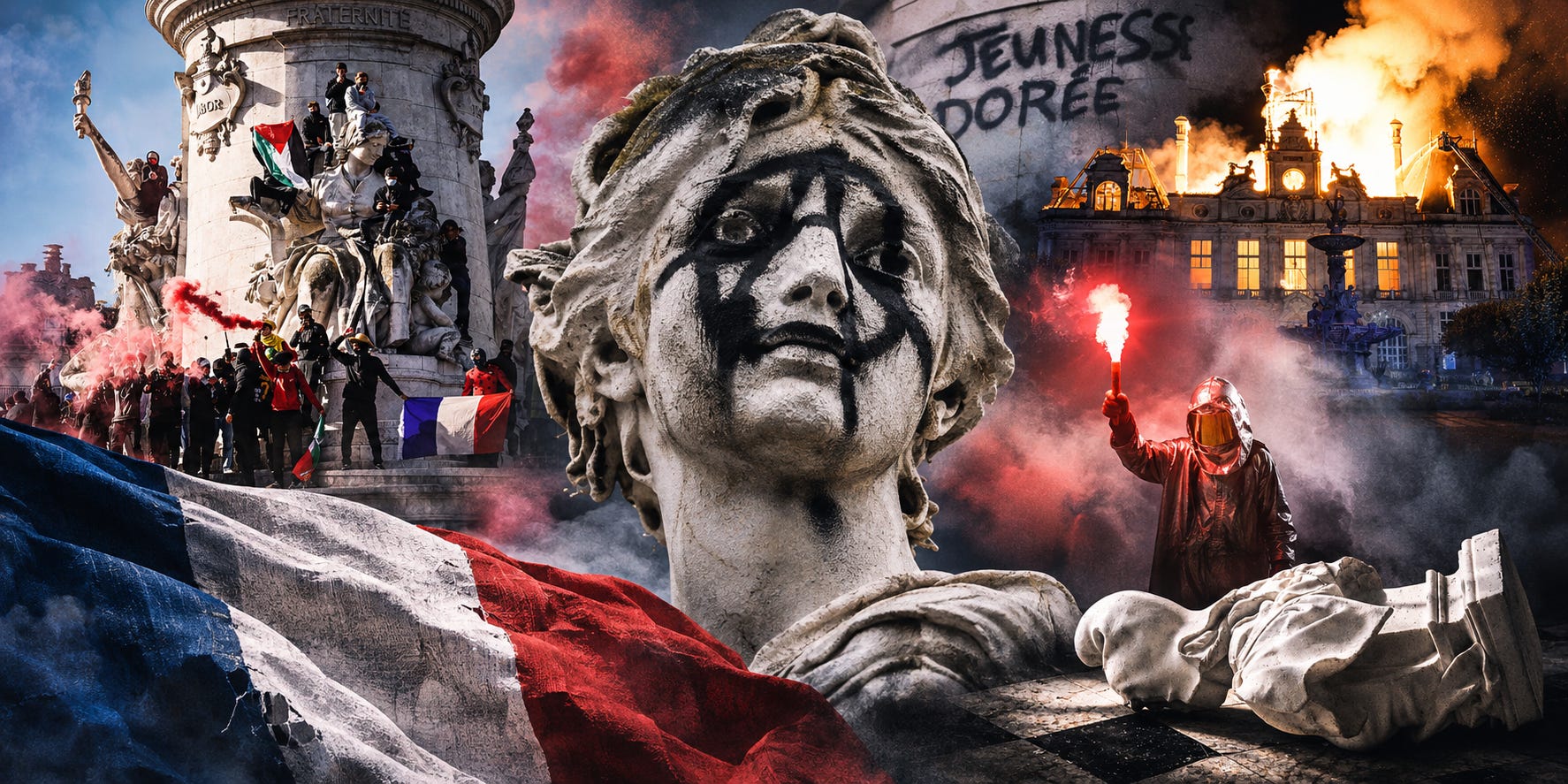
They burned the town hall at Limoges. They ransacked the city hall in Marseille, a beautiful old building from 1653 that had survived even the German demolition of the port in 1943. They burned the tourist office in Lyon. And they dragged a statue of Marianne into the street.
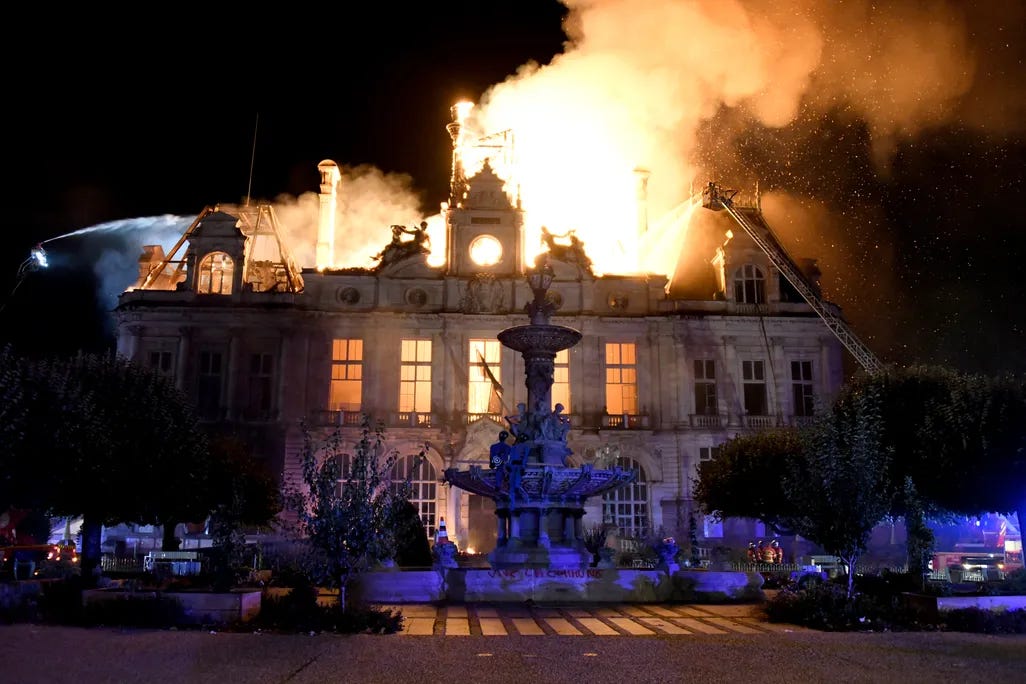
The media has framed all of this as an uprising over the cost of living, but what about the cost of living is addressed by burning a beautiful historic town hall? Wouldn’t a tax office have made the economic point? The government’s own account is that the arson was not the work of the marchers at all but fringe militants and looters who attached themselves to the day — a convenient misdirection.
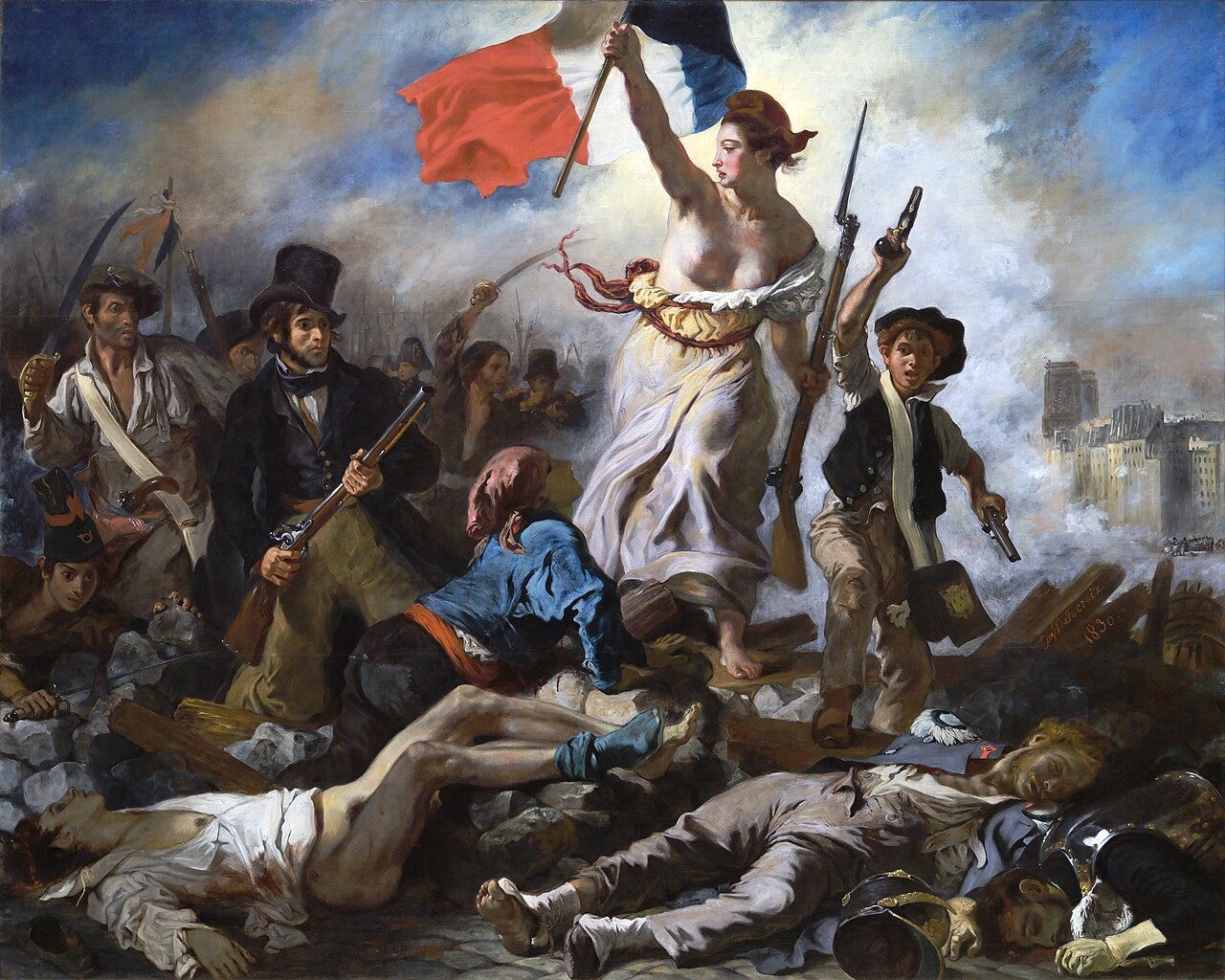
Truth is, they were intent on burning more than buildings. A town hall is where people were married and births were registered, and the one at Limoges had stood through two world wars. Marianne, whom they defiled and defaced, is more than mere decoration. She is the closest thing the French Republic has to a holy image. The Revolution invented her to occupy the place the Christian saints had formerly held. You know her face without the name, from Delacroix’s bare-armed woman striding over the barricade with the flag. In France she is a bust in the entrance hall of nearly every town hall in the country, standing roughly where a statue of the Virgin would have stood in a parish church. Both are sacred objects in the only sense that matters here: things a people have agreed to treat as set apart.
In case you are tempted to think that these “revolutionary” acts are something new in France, they are not. The deliberate humiliation of sacred things is the oldest practice in French public life. The French have been at it for more than two centuries, and some might say they invented the modern form of it.
Why the sacred
Start with why the sacred is the target at all.
Sacred things are the strong things in a society. You grow up knowing you are supposed to value them, to be in awe of them. That is the point of being set apart. You cannot debate the sense a man has, standing inside a church whose stone ceiling was raised eight centuries before he was born, that he is small and late and owes something to the dead. It is the reason we whisper in a graveyard for soldiers and tear up when the national anthem is played.
But to a revolutionary that strength is also an obstacle. Strong bonds to a higher order often bring unity and devotion across a lower one. Belief in your nation, your history, your shared heritage, your kin, and underneath all of it your religion, works as a firewall — no pun intended — against manipulation and distortion. Anyone who wants to remake a society therefore has to get past it, has to overcome its power and its memory. There is only one formula for that: humiliation.
Humiliation is the chosen tool because it works where naked aggression and careful argument both fail. Destroy a church and slay its leaders and you have paid it a compliment, and quite possibly ignited a counter-revolution of the martyrs; you have conceded it mattered enough to burn and kill for. Degrade it in public, however — keep its shape, co-opt its leaders, use it to say the opposite of what it was built to say — and you have taught everyone watching that there was never anything there worth respecting in the first place.
While no expert on French history, I have read enough to notice a pattern. There are only two things a man can do about something standing above him: kneel and accept its authority, or pull it down and assert his own. In 1793, France chose the second.
The Revolution:
Everyone knows about the guillotine. What struck me the further I read was how much of the culture-transforming work had nothing to do with killing anyone. Theirs was a revolution less interested in winning an argument of ideas than in delegitimizing everything that had been strong before it.
They profaned. It started with sex, which helped prepare the soil of the Revolution. For twenty years before 1789 the underground presses flooded Paris with scandal, much of it pornographic and most of it aimed at the Church — convents, lascivious monks, ruined nuns — and then turned the same machine on the queen, accusing Marie Antoinette of orgies, lesbianism, and incest with her own son. Scholars who reconstructed the illegal book trade, found attacks on religion to be its largest category. You do not refute a bishop’s authority on his own religious terms. You debase him with shocking imagery, cheaply, for decades, until nobody can hear him say the word chastity without laughing. They are not set apart. They are just like us.
Then the bodies of the saints. What about those who had already died, the ones who had taken a cherished place in the collective memory? They took the bones of Sainte-Geneviève, patron saint of Paris, credited with turning Attila away from the city in 451 by calling it to prayer, out of her final resting place. She was put through a sham trial, convicted of being a fraud, burned in a public square, and her ashes scattered on the Seine. Destruction was not good enough for the crowd. The trial, the fire and the scattering are what made it a desecration.
They gave their kings the same treatment. In August of 1793, the Convention ordered the royal tombs destroyed. All told, more than 170 bodies were thrown into two pits dug at the monks’ cemetery. Among them were 46 kings, 32 queens, and 63 others of royal blood. Two dozen of the monks who had run the place went in with them.
Henri IV’s coffin was prominently displayed before he joined the others in the pit, allowing onlookers to chip off teeth, fingernails, hair, and other preserved body parts. Legends tell of one man taking home from the various bodies a jaw, a skull, teeth, and even one of the royals’ legs.
The French authorities who run the basilica today have a funny way of describing the horror that happened there: the desecration of the royal tombs. Not destruction, not vandalism, but desecration. A word imbued with sacred meaning. A word you only use if you feel something has been violated, something that was supposed to be set apart in the first place.
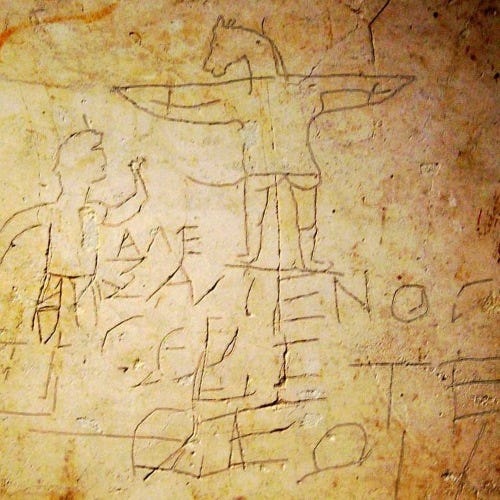
And it did not stop there. The Holy Mass itself: at Lyon a donkey was dressed in a bishop’s hat and robes with the communion cup hung around its neck and the Mass book tied to its tail, paraded through the streets, and at the end made to drink from the cup while the book burned. For people who believed that cup had held the actual blood of Christ, this was a horrifying sight — which was the point. The men at Lyon had not invented anything. The insult is as old as the faith itself: around the year 200 somebody scratched a crucified figure with a donkey’s head into a wall in Rome, above the words Alexamenos worships his god. Sixteen centuries later, a revolution busy abolishing every tradition it could find kept that one faithfully.
They renamed. Next they went through the country changing what things were called. Do not miss the significance of this. It is an erasure of traditions and norms, and ultimately of a country’s collective memory. The calendar was rebuilt from scratch: the seven-day week replaced by one of ten days, the Sabbath and any mention of Sunday abolished, the saints’ days — attached to so much family memory and celebration — struck out and their dates reassigned to plants and animals and farm tools, the years now counted from the founding of the Republic rather than the birth of Christ. Christmas became the day of the dog. Marseille, which had displeased the Convention, was stripped of its name and called Ville-sans-Nom, the town with no name. And most famously, Notre-Dame became the Temple of Reason.
They replaced. On November 10, 1793, a living woman was carried into the choir of Notre-Dame and enthroned there as a goddess. That is where the Marianne in the town hall comes from.
But notice what none of it is. They did not raze Notre-Dame and build something else on the ground. They kept the building, the processions, the vestments, the singing, a calendar with days set apart. That is not construction. It is occupation, and every act in it is a humiliation ritual structured to redirect the veneration of the common man toward a new strong god — the French Republic.
What they kept
Oddly enough, the regime that would guillotine a king and drown priests by the barge still could not bring itself to say that nothing was sacred.
Within a year it had a goddess, a calendar and temples of its own. It is almost like it needed a celestial justification for the premise laid deep under its own Declaration of the Rights of Man: that a person is owed something regardless of rank or usefulness. The regime identified with liberty, equality, and fraternity, but did not have the theological underpinning necessary to justify such a bold claim.
The fruit France wanted to preserve entered Europe attached to the image of God. It has no other source. France by the revolution had been steeped for centuries in the idea of dignity and equality that came from the gospel. They wanted the value without its story, without its history, without its legacy, without its icons, without its buildings, without its clergy. They rooted that value in their own human hearts and relied on their own reason: not an ancient order standing outside themselves, but one that lived inside them. Which is what a Temple of Reason is.
Metaphorically they stood hacking at the roots of the tree believing that the fruit would keep coming for their children. How did they forget what made it bloom in the first place?
Humility and humiliation
Speaking of roots, humility and humiliation share one. Both descend from humus, the ground. The only difference in this building and tearing down of nations is who gets brought down to the ground, and by whose hand.
Those few daring revolutionaries who have embarked on nation building experiments had to constantly contend with both.
Humility is lowering yourself, and it requires you to believe there is something above you worth kneeling to — recognition of a power above you and beyond you.
Humiliation on the other hand is lowering someone or everyone else, and it is what a man carries out when he refuses to believe he is beneath anything at all. If you will not kneel, the altars must be pulled down beneath you.
Within fifteen years of each other, two separate nations of revolutionaries threw off a king. America declared independence in 1776; France took the Bastille in 1789. Both were rejecting a monarch who claimed divine appointment.
One of them chose humility. The other chose humiliation.
Every weapon France chose to wield was available to the Americans, and yet they are separated by how few they chose to use. They kept the seven-day week and they kept Sunday. They kept counting the years from Christ. And they kept the common law — a body of rules nobody designed, accumulated by judges case by case over six centuries, resting on the premise that law (and wisdom of judgment) is something you inherit, build, and guide rather than something you compose fresh with the wisdom of every new generation — notice the inherent humility in that? A belief in the collective wisdom of years, that things may be the way they are, and some things may have survived not because of power dynamics and oppression, but because of wisdom.
Americans wrote their central premise into the opening of their founding document, ahead of every grievance against the king: all men are “endowed by their Creator with certain unalienable Rights.”
France wrote its premise down too. Article 3: “The principle of any Sovereignty lies primarily in the Nation.” Article 6: “The Law is the expression of the general will.” It opens by invoking God too — the whole thing is proclaimed “in the presence and under the auspices of the Supreme Being.” But notice the posture. One document has God endowing. The other has him watching. The same vocabulary of rights, and the source has moved from outside the people to inside them. A right that comes from a Creator is not the state’s to grant and therefore not the state’s to withdraw. A right that comes from the general will lasts exactly as long as the will does.
The split goes back further than either document. The Americans revolted over rights they believed they already held — the rights of Englishmen, representation, charters, the common law — and their complaint was that these were being taken from them. The French hated their monarch as well, but their foundation for taking that God-given authority and dispersing it to the people was where the two eventual republics diverged. The Americans reestablished the rights they claimed to have inherited and built a government whose only job was to guard them, keeping everything they could and changing only what they felt was necessary. The French wanted nothing to do with the past, destroyed everything, and began again from nothing.
Crucially, if ultimate truth sits outside the people, no man can embody it, and the founder’s task is to steward it, hand it off, and get out of its way. If truth sits inside the people, it has no consistent voice of its own and has to borrow one, and whoever speaks for the general will commands it. A nation with nothing above it always ends up with somebody over it.
On December 23, 1783, at Annapolis, George Washington stood before Congress and gave the army back. “Having now finished the work assigned me, I retire from the great theatre of action, and bidding an affectionate farewell to this august body, under whose orders I have so long acted, I here offer my commission, and take my leave of all the employments of public life.” One delegate wrote that his voice faltered and sank; another recorded a copious shedding of tears. He bowed, and rode home to Mount Vernon for Christmas. The story told afterward was that George III, hearing from his painter that Washington meant to go home, said that if he did it he would be the greatest man in the world.
Then he did it again. Called back to preside over the Constitutional Convention, he went. Elected president, twice and unanimously, he served. He could have held the office for life and everyone understood that, including him. He wrote a farewell instead and went home a second time, and the two-term limit held for a hundred and forty years on nothing but his example.
Both of those were submissions. Made publicly in rooms, in front of witnesses. Twice he had the chance to stand above something however artificially, however temporarily, and twice he bowed himself beneath it on purpose.
Then Napoleon arrived, and he wanted more than the Revolution could give him. He took power in a coup, and then he put every step of his rise to a public vote and won — First Consul, then Consul for Life, then Emperor. If the general will really was the only authority in France, he already held everything there was to hold. It was not enough. It never was. The only thing better than democratic power is total power and hereditary power, and democracy hands you neither: it cannot make a throne divine, and it cannot pass it on to your heirs. The only institution in Europe that could do both was the one the Revolution had spent ten years dismantling.
So he put it back. The Concordat he signed with Pius VII in 1801 returned the Church to French life and Notre-Dame to the Church — by then the cathedral had stopped being a Temple of Reason and become a warehouse for wine. A new bishop was enthroned there on Palm Sunday 1802, and Napoleon attended the Easter Mass a week later at which the agreement was read out. He spent real political capital restoring an institution his own Republic had been built to destroy.
Thirty-two months later he was ready to take it back.
On December 2, 1804, in Notre-Dame, Napoleon took the crown off the altar and put it on his own head. Pope Pius VII sat and watched, and then blessed him.
Traditionally a coronation was a sacred act: the Pope placed the crown on the emperor, because the authority was God’s and it reached the emperor through the Pope’s hands as a vessel. That was the whole meaning of the ceremony. Napoleon changed one thing about it. He kept the Pope, the vestments, the altar and the prayers, and he moved the crown himself.
Which is why the restoration of the Church, however artificial, had to come first, because picking up a crown off a shelf in a wine warehouse means nothing. But summoning the Pope, making him anoint you with his own hands, and then pulling that same crown off an anointed altar is a different game entirely.
This is the madness: destroy something so totally that you must resurrect it from the dead, only to transfer its power once more in a ritual of humiliation.
Set the two men’s lives beside each other and you begin to understand the trajectory of the nations. Washington’s life gave something away, in public, twice. Napoleon’s reached up to an altar to grasp at power over and over again.
Twice he was beaten, and twice he was exiled. In 1814 the armies of Russia, Prussia, Austria and Britain marched into Paris, he abdicated, and they gave him the island of Elba. Less than a year later he escaped the island, landed in France with about a thousand men, and took the country back without firing a shot; the regiment sent to arrest him joined him instead. The Hundred Days ended at Waterloo, and the second island exile was St Helena. His overextension, his ambition: nothing more than the tale of Icarus, flying too close to the sun.
At the end, on St Helena, Napoleon was still measuring himself against Washington. He knew what Washington would be remembered for, and he spent some of his last conversations explaining why that had never been available to him. “Had I been in America, I would willingly have been a Washington, and I should have had little merit in so being.” Of Washington in France: “I would have defied him to have been what he was in America; at least, he would have been a fool to attempt it.” And of himself: “For my own part, I could only have been a Crowned Washington.” That is a proud man wrestling with his own legacy. I do not believe he had an ounce of Washington’s humility, but sift through the pride and something true is left at the bottom of it. The soil the two of them planted in was not the same soil. France was not America, and the man who chose not to be Washington understood exactly why.
France has had more than a dozen constitutions since 1789. America still operates from its original.
The method
Nietzsche said it plainly a century later: God is dead, and we have killed him. His madman says it to a crowd in a marketplace and is greeted with laughter. The townspeople have not yet grasped what they have done. If man is going to stand at the center of the universe, everything else around him must be brought down. There is no arrangement in which both God and Man share the throne.
The method was not complicated. The revolutionaries knew they could not fight the strong gods on their own terms — truth, patriotism, family, religion, God himself — so they set out to delegitimize them instead. A parasite fastened to its host, drawing the power out of it and transferring that power into man and the empire that man builds for himself. Everything in 1793 was that single operation: the pornography, the bones, the donkey in a bishop’s hat, the renamed days. Not destruction. Extraction. Transfer.
Which is why the chaos in France never ends, and why it keeps choosing the targets it chooses. The town hall rather than the tax office. Once a French crowd has decided to rebel, can anyone expect it to stop there? They are trying to capture the attention of the people above them, and they only really know one way to do it. It is the only thing they have been taught, for more than two centuries. The ultimate rebellion available to a Frenchman is to violate whatever is left of the sacred.
These protesters do not treat voting, or parties, or petitions as the real way to be heard. They treat legitimacy as something you take — pulled off the people in charge by defacing whatever those people hold sacred: their history, their memory, their buildings, their patriotism. They go after whatever still looks strong.
This cultural ethos was celebrated on the largest stage there is.
On the night of July 26, 2024, France opened the Olympic Games on the Seine, and this is what it chose to show the world. Along one side of a long table, more than a dozen drag and transgender performers struck poses, a child among them. At the center stood a DJ in a silver headdress made to look like a halo. The arrangement was Leonardo’s Last Supper, and the producers later conceded that the painting had been an inspiration. Then a great silver serving dish was opened, and in the place where the bread and the wine belong lay a nearly naked man painted blue, playing Dionysus, the god of wine and intoxication, pointing at his own groin and singing.
The Last Supper is the meal Christ ate with his friends on the night he was betrayed, where he took bread and wine and told them it was his body and his blood. Every Mass said anywhere on earth for two thousand years has been a return to that table. France took the table, filled the seats with a parade, and set a naked blue god of drunkenness on the plate where Christ had put himself. That is not a feast of the gods. It is the same ritual twice, two hundred and thirty-one years apart: at Lyon an ass in a bishop’s hat, made to drink from the communion cup; on the Seine a naked blue man laid out on the plate where the bread and the wine belong.
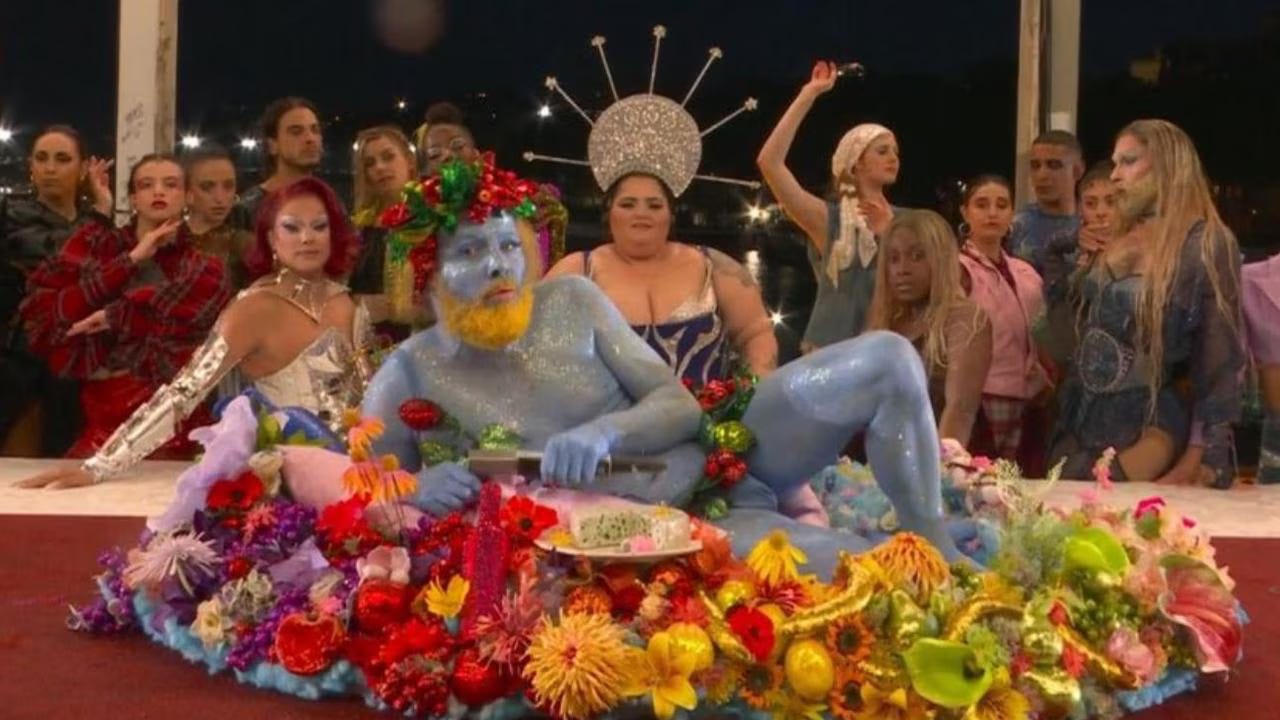
An opening ceremony is the one night a nation gets to tell everybody watching who it is. France had the floor and the attention of the world, and what it elected to perform was the mockery of the holiest meal in the Western world. France was not being humiliated that night. It was demonstrating its triumphal culture of humiliation, as an achievement, in front of everyone.
Still, take it in its best light for a moment. There is an element of respectable bravery to be found in a people willing to humiliate anything at all. Aimed well, it makes a bold and sometimes necessary political point, and it dares to tread where everyone else may be too intimidated to venture. In some respects it has given France a kind of nerve the rest of Europe does not have — and it is the reason the same country gave the world Charlie Hebdo. Where else would that magazine have come from?
For anyone who does not know it: Charlie Hebdo is a French satirical weekly that has spent fifty years mocking everybody — Catholics, Jews, politicians, the devout of every description. In the 2000s it turned the same pen on Islam and printed caricatures of the Prophet Muhammad, which Islam forbids absolutely — on threat of violence. Its offices were firebombed for it in November 2011. It kept printing. On the morning of January 7, 2015, two Islamic terrorists walked into the weekly editorial meeting with rifles and murdered twelve people — cartoonists, a columnist, a bodyguard — then shot a wounded policeman, Ahmed Merabet, in the head as he lay on the pavement outside. They shouted that they had avenged the Prophet. Al-Qaeda claimed the killings as revenge for Muhammad’s honor. Two days later an accomplice murdered four Jews in a kosher supermarket.
In response, “Je suis Charlie” went round the world, and the magazine’s profanations — aimed for decades at popes and rabbis without distinction — became a banner for free speech. France’s oldest habit was in this instance seen as an admirable virtue.
Now ask why it was France. Of all the nations of Europe, the one with the nerve to put Muhammad on a cover, and to go on doing it after the firebombing, is the one that has treated the profaning of sacred things as civic practice since 1793. The courage and the contempt come out of the same place. Nothing is off limits there. Christianity, Islam — it makes no difference. It is who they are, and who they have always been.
So when this new generation of political activists shows no respect for the last few things the establishment still calls sacred, who could be surprised?
It is true that many of the faces in the street now are immigrants, and many more are the French-born sons of immigrants. But you cannot lay the defacing and the debasing and the destroying solely at their feet, like they carried in a unique disrespect France was short of. This is no new form of radicalism. It is the oldest thing in the country. The only sacred thing in France is the disrespect for anything set apart.
In 2016, rioters smashed windows at the Necker Children’s Hospital in Paris, an incredibly historic monument, as it is the first and oldest children’s hospital in the world. In December 2018 the yellow-vest protesters broke into the Arc de Triomphe, gouged the face of a plaster Marianne, decapitated a marble bust of Napoleon, and slashed a painting of Victor Hugo, the author of Les Misérables, being welcomed beneath the arch by a swarm of angels, one of them holding out the French flag.
A spokeswoman for the French Interior Ministry put the number of anti-Christian acts in 2023 at just under a thousand, about nine in ten of them against churches and cemeteries. In the riots that followed the police shooting of a teenager outside Paris that same summer, a hundred and five town halls were burned or damaged, along with two hundred and forty-three schools, out of some two and a half thousand buildings in all. The Senate’s own inquiry put it flatly: “Les cibles des émeutiers ont été orientées vers des symboles républicains.” The rioters’ targets were aimed at republican symbols.
There is one thing left that everybody in France still sees as untouchable (or so I thought). Under the Arc de Triomphe, Napoleon’s victory arch, lies an unidentified French infantryman — this is France’s version of Arlington Cemetery, one of eight anonymous bodies brought back from the battlefields of the First World War, buried there in January 1921 to stand for every Frenchman who did not come home. A flame was lit over him on November 11, 1923, and the veterans’ associations have come at six thirty every evening for more than a century to rekindle it.
You can have no use for God, no use for the Republic, no use for any party or any church, and still take your hat off to a man who died defending the homeland. Left and right, believer and atheist, all of them stop at that grave. Call it the last sacred French space.
And yet, recently it has been violated twice. During the violence of December 2018, French protesters trashed the grave; the reservist who came to guard it described clearing away the eggs, beer cans, and the urine.
Seven years later a Moroccan homeless man climbed the barricades to light his cigarette off the eternal flame. French authorities wavered in how to charge him, eventually settling on desecrating the tomb. Desecration. One minister announced he would strip the man’s residence permit, but he was blocked. The court ended up retreating, suspending any sentence and fining him the incredible sum of one euro.
Maybe this was a drunken man’s harmless mistake.
But what does it tell us that the French state could not bring itself to protect the soldiers’ tomb?
Its reasoning for the act being wrong was a hollow and hypocritical attempt to keep a few things off limits in a culture that respects almost no boundaries at all. Imagine for a second American protesters vandalizing and urinating all over the graves of Arlington Cemetery. The condemnation in America would be swift, total, and bipartisan, with nobody on either side hunting for a reason to excuse it.
So that brings us back to today. Marianne, the sacred lady of the Republic, lies face down in a Marseille street, defaced, while a new generation of citizens take their selfies beside her and wallow in her humiliation. There is no argument left in France that can pick her up. She was never going to survive on her own. She was created in a power vacuum, borrowing authority from a holy order long ago hollowed out.
In 1793 the strong things in France were the Church and the crown. The crown is gone. The Church is still standing (worn down in France, still a power in the world, and still being hit a thousand times a year). What has now evolved is that the Republic itself is now seen as sacred: its buildings, its registers, its monuments, its memory, the whole apparatus the Revolution built and then filled with the authority it had taken from God. The old guard finds it shocking that this is now a target, and you can see why — they built it, and they moved the sacred into it with their own hands. What they cannot admit is that these tactics are what also made it vulnerable. They are being destroyed by monsters of their own making. The script does not care what the object is. It is written only to go after what is left standing. What is left still strong. And where would this generation have learned otherwise — the ones who arrived, and the ones born here alike? Not from a state that staged the Last Supper on the Seine.
So what is the lesson?
That when you kill God, you spend the rest of your history killing one another over to claim the empty throne? That when you root your morality and your reason in anything but a higher and unchanging power, you are doomed to be tossed about by whatever the culture happens to believe this year?
Both of those are true.
But I doubt the rioters have processed any of this. I am not so sure this was that strategic. Nobody stood outside the town hall at Limoges and reasoned out what it truly stood for. No, they were just reacting out of their training — doing what they have always been taught. For the French, this is a rehearsed cultural script, and the lines flow naturally.
ABOUT THE AUTHOR:
Currently, I serve as the Executive Director of Them Before Us, advocating globally for the rights and well-being of children.
I am also the co-founder of All The Good, a leadership organization helping non-profits do all the good they are called to do.
I studied Cross-Cultural Ministry and Humanitarian and Disaster Leadership at Messiah and Wheaton. I read a lot and sleep less than I probably should.
