
The Fertility Wars
Egg freezing, IVF, and what it will actually take to avoid extinction.
This past week, Alexandria Ocasio-Cortez posted a video of herself taking the medication necessary to prepare her body for an egg retrieval, revealing that she is planning to freeze her eggs.
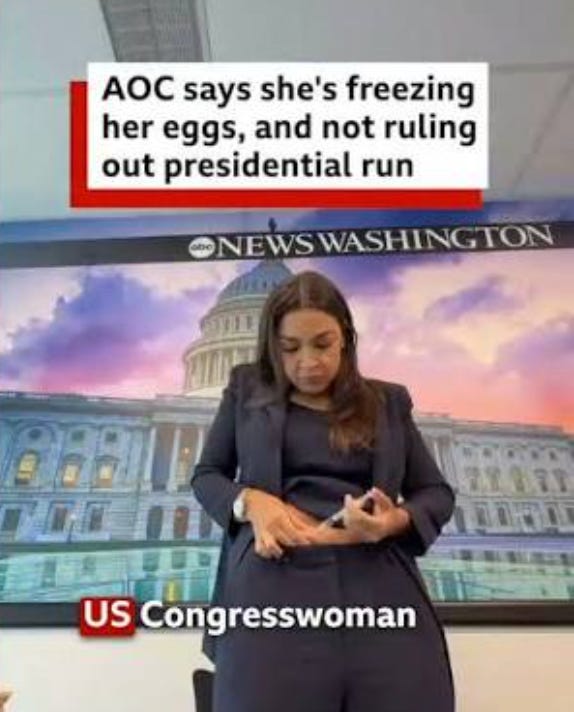
She said, “I want you all to see that, because women can do anything. And I think it’s badass that I’m gonna be giving myself shots in the green room, get my glam on, roll out, talk international events, domestic policy, elections, pop out, live my life, do my thing.”
The video kicked off a firestorm online, and the latest round of what I have come to call the fertility wars. The last year or so has given us several high-profile battles.
Meghan Trainor announced her third child, born through a surrogate, after deciding that the safest and easiest way to keep building her family was to hire someone else to do it.
Fox News host Guy Benson announce the birth of his daughter Madison, the second child he and his husband have purchased eggs and rented a womb to create.
And Alex Cooper, the famous host of the “Call Her Daddy” podcast, a show that encourages women to avoid the patriarchal institutions of marriage and family surprised her audience by posting a picture of her stomach out of the blue, captioned “our family.”
The White House got in on the action as well. Karoline Leavitt became the first White House press secretary to give birth while in office, even posting pictures of herself typing with one hand while feeding her nine-month-old a bottle.
Usha Vance welcomed her fourth child just a few weeks after the family announced the installation of their massive chicken coop in the backyard, with pictures of their growing family picking up little newborn chicks and running all throughout the yard.
Two sides, two sets of flaws
As conservatives and progressives line up on opposing sides of this debate, their worldviews and their respective flaws come into focus.
On the progressive side of this war is a group hell-bent on selling extinction. None of it is better represented than the abortion truck parked outside the DNC convention, but it extends beyond that to their push for expanded access to birth control, government funding of everything from egg freezing to IVF, and the promotion of normalized surrogacy for anyone who wants to acquire a child.
Their mindset is one that demands complete and utter control over life. Universal access to children by any number of adults. Sovereignty over when you can create them, biology be damned, and when you can end their life, up to birth, for whatever reason you like. And throughout the process, the ability to design them to the specifications you desire, no matter how superficial. What they look like. How tall they will be. Even what IQ they might have. The ability to stop, start, and outsource reproduction with the help of technology and no repercussions.
Children have essentially, in this worldview, become a totally commodified asset to be cut, transferred, placed, eliminated, or acquired at will, with every impediment cleared away by superior technology and public money.
I want to be precise about how total this is. There is almost no one on the left applying any serious thought to the rights of a child, to what they are owed. No one demanding they be protected in the womb, or paying any attention to their claim to be raised by their mother and father. No one is contemplating whether it is ethical to manufacture a child to order, to sell them, to outsource gestating them, or to discard them when the product isn’t up to snuff. Their entire apparatus is built around what the adult wants right now and how the marketplace can deliver it. A child is an asset to be acquired.
The only concession I will grant, and I do this with great hesitation, is that I believe some in their party have arrived at their desire for complete control because of a hyper-fixation on the economic realities facing families, and particularly women. I hesitate because under no circumstances does any of that justify killing a child. But I think it is proper to acknowledge that in their language, SOME are at least raising a legitimate issue about the ways our economy has made it genuinely difficult to raise children.
Pro-birth is not pro-child
On the other side we have the conservatives, who have their flaws, but who are, to be clear, more hypocritical/misinformed than evil in my estimation.
They have adopted a pro-birth (at all costs) mentality, wanting children to exist and believing that they are good for society and good for mothers and fathers. For a civilization currently talking itself into extinction, wanting more children born and recognizing all the good they bring with them is the correct instinct.
The problem is that pro-birth and pro-child are not the same thing, and a significant faction within the conservative movement has an insufficient appreciation for the difference.
Take IVF. This is a technology that ends far more lives than it ever creates. Its scale of embryonic destruction outpaces even the pro-abortion establishment and evil actors like Planned Parenthood. The fact that it is now being promoted by a supposedly conservative administration, and cheered on by individuals who have spent the last fifty years insisting that life begins at conception, is at best hypocritical and at worst truly malevolent.
BTW… if you have never heard of IVF or want to learn more about these arguments here are a few articles I have written on this topic before:
Conservatives also have their own track record of misplaced compassion, proving they are not immune to it either. We saw that in July, when Guy Benson announced his daughter’s birth and was greeted by prominent so-called conservatives like Nikki Haley and Dana Perino. These are individuals who in any other context would advocate for every child having a mother and father. Again, they gave what seems to be no thought at all to the fact that this baby girl was deliberately deprived of her mother and separated at birth from the only woman she had ever known, based on a contract and a payment likely in excess of six figures.
My hope is that within this movement, which claims to value children and has traditionally embraced the pro-life cause, we only have an education gap to overcome. As people begin to understand the true horrors of the IVF process and the inhumanity of intentionally depriving a child of a mother or a father, we will continue to win converts to the pro-child perspective. Many will realize that their support of IVF, surrogacy, and child acquisition was the product of ignorance and misinformation, of never having thought the issue through.
But that still leaves us with one more challenge, and I don’t think the conservative movement is doing nearly enough to address it.
Presencing children in public spaces and alongside people in powerful/influential positions is incredibly important, and it does much to reshape society’s acceptance and celebration of children. However, I am afraid that this mindset often implies a “you can have it all” mentality that doesn’t appropriately grapple with the fertility-suppressing realities of our present economy. We have told people to have their kids earlier and stop making excuses. The sentiment is correct, and I do think having children within the context of marriage produces outcomes beneficial for the family and for society.
But conservatives could take a lesson from the left here and start taking seriously the real pressure so many are facing. We can do that without reaching the left’s monstrous conclusion that we should suppress and destroy our fertility through chemicals and delay, or destroy the child to avoid facing that pressure at all.
The birth rate is a symptom
Let me end this piece with a few final thoughts on the fertility wars and how we might save civilization from its current disastrous decline.
The first is that I firmly believe the birth rate is a symptom. What we are witnessing now is happening downstream of a culture captured by a dehumanizing view of children and a depressing view of family. When you combine that with a misguided pursuit of birth at all costs, you get IVF mills, rented wombs, children built to spec, and an industrial childcare complex that outsources a child’s most important moments to paid help.
A higher birth rate at that cost is no victory at all. If we fix our number, which I would like to point out we are not even doing under the current regime, but lose our children and destroy our families in the process, we will have nothing left to save.
The question is not how we get more efficient at creating children at scale. The question is how we orient society around children and become truly pro-child.
What my generation is talking about
In the spirit of transparency, I have four kids. I am married to a woman with a master’s degree who is deeply fulfilled by her work. We got married early and started having children in our twenties. Both of us have worked, full-time or part-time, during their entire lives, and both of us did it while attending grad school. We have utilized family (which is a huge and irreplaceable blessing). We have utilized daycare, and at times a team of babysitters. Put simply, we could have done it without them.
So what does my generation, the ones who have lived in the middle of the crossfire of the fertility wars, actually think?
I’ll tell you. Any time I am around my friends, the same conversation comes up. What’s your mortgage rate? How many kids do you still want? How many more years do you have left on your student loans? Do you think your wife will keep working? Can you go remote? Whose insurance are you on?
For some of us, the ones I’ll call lucky in this conversation, we locked in by the grace of God what we affectionately call our forever homes, thanks to dramatically low interest rates and a once-in-a-lifetime window. But talking to my not-so-lucky friends, especially those who entered the housing market just a few years after us, had we faced their mortgage rates, even at the same price we paid for our house, those payments would be unsustainable and astronomical.
Just this past week I heard the phrase that a hundred dollars is the new twenty, and it unfortunately rang true. It doesn’t seem like you can get a few back-to-school supplies or half a cart of groceries without shelling out hundreds. A six-figure salary used to be something you dreamed of, the pinnacle of a career. Now you are hoping that you and your spouse can edge over that mark together just so you can have a little breathing room.
My generation is having this conversation while we watch our parents sell our childhood homes for 5-10x what they originally paid. And they really wonder why people aren’t having kids? Trust me, it is not because we are wasting our money on five-dollar lattes.
What would actually help
Lest you think all I am going to do is complain in this article, I thought I would share a few ideas I’ve read, heard, or thought about over the past several years. To be frank, none of them are a silver bullet. Cultural change is bigger than one government program, or flexible corporate remote work policy. What is truly needed is a societal shift that reorients life back toward children. Spaces and structures that consider them, economies that help parents afford them, and communities that celebrate them (and the mothers and fathers willing to create them).
CHILDCARE: We need to stop pretending that subsidized childcare is an ideal and fixture of modern working life. Why can’t we imagine a society where one income (or at worst 1.5 incomes) is enough to provide for a family. Diverting our tax dollars into programs that pay someone else to raise our children should be a last resort or temporary measure for those in poverty, not a new American dream. Tim Carney, who wrote Family Unfriendly, changed his mind on this while researching the book and now argues that subsidizing childcare mostly subsidizes work. His alternative is the right one, if you are going to fund it, give the money to parents directly and let them decide. Some will spend it on daycare. Others will use it to dial back their hours, or to build out a room for a grandparent, or to move closer to the friends/support systems that make child rearing easier.
I believe we should assist the families who genuinely need it, many of them headed by single mothers dealing with an unfortunate family breakdown. Being able to provide that so they can get back on their feet and move off of dependence is a good thing. But a lifeline can never become our policy ideal.
HOUSING: no starter home should be carrying a $4,000 mortgage. When foreign investors and private equity funds are bidding against young couples for the same entry-level houses, we have already decided whose returns matter more. Restrict it. A country that says it wants families should be protecting its houses for families rather than for stock portfolios.
STUDENT LOANS: how about we start holding colleges accountable for the degrees they are selling and the money they are lending? Why is it that an eighteen-year-old can sign away their future under a mountain of debt for what is an incredibly unstable asset? Student loan programs aren’t auditing which school the student has attended, which program they are enrolling in, or how that compares to their potential earnings. I can’t think of another instance where the party lending a quarter of a million dollars wouldn’t ask some basic questions. And maybe, while we are at it, we could begin idealizing, incentivizing, and promoting alternative forms of education, like the trades, or the kind of degrees and technical certificates in industries that are going to produce a living wage. Brad Wilcox, author of Get Married, argues for redirecting educational spending toward exactly that kind of career and technical training, and for opening school choice vouchers to everyone, homeschoolers included.
If we think that a couple carrying an extra thousand dollars a month in student loan payments, with twenty-five years left on the clock, is not having their fertility suppressed by it, we are kidding ourselves. For many that is half a mortgage payment, or the ability to finance a car that fits a growing family. For many, it is the third or fourth child they will never get to have.
MARRIAGE: how about we incentivize the structures we know produce the best outcomes for kids? (and by the way, are the cheapest long term for society) Why don’t we support the choice of a man and a woman to get married and raise their own children? Wilcox proposes expanding the child tax credit and giving parents who choose to marry a twenty percent supplement on top of it. He also points out that we currently do the opposite. Programs like Medicaid and public housing are built on income thresholds that reward single parents but punish a couple for getting married. This means we are fining people for forming the exact households we claim to want and that children desperately need.
If marriage bonuses sound “unfair” to you, remember: without the willingness of mothers and fathers to sacrifice, even under these economic conditions, we would have an upside-down country and a demographic cliff like the one much of Asia is staring down right now. Why would we not give the people helping us stave off extinction every resource possible?
HOSPITAL BILLS: And don’t get me started on birth costs. I know several families who, on their child’s fifth or sixth birthday, finally finished paying off the medical bills from that child’s birth. Think about what that means. They spent the first eight years of their kid’s life paying off his arrival. No pregnancy should be putting people into bankruptcy. Talk about a way to guarantee no one wants to have kids. How about we create a system where no one who has chosen life walks into a delivery room afraid of the bill?
Inflation, healthcare costs, student loans, mortgage rates. These are all opponents of a pro-family culture. Right now they are the true obstacles in the fertility wars.
Our only two choices
At the end of the day, children may wreck your career timeline. They will make you less productive (for a season) than your colleagues. But they will also make you happier, more fulfilled, and living a more purposeful life than anyone else, especially when you do it in the context of marriage.
All of the challenges I have listed out today have never been good enough reasons to start or stop families. Bearing and raising children is a society’s most basic duty.
It really doesn’t get any simpler than this. We either fix our upstream problems and embrace a more pro-child culture, or we go extinct.
Those are our only two choices.
ABOUT THE AUTHOR:
Currently, I serve as the Executive Director of Them Before Us, advocating globally for the rights and well-being of children.
I am also the co-founder of All The Good, a leadership organization helping non-profits do all the good they are called to do.
I studied Cross-Cultural Ministry and Humanitarian and Disaster Leadership at Messiah and Wheaton. I read a lot and sleep less than I probably should.
My wife and I live in Charlotte, North Carolina with our 4 kids.


