


The Swinging Bridge is Messiah University’s official student magazine, housed in university facilities and funded through the student activity fee that every enrolled student pays each semester. It is not an underground publication, it is located on Messiah’s campus, supported with Messiah’s resources.
A few days ago, a friend sent me a copy. I was floored by what I read.
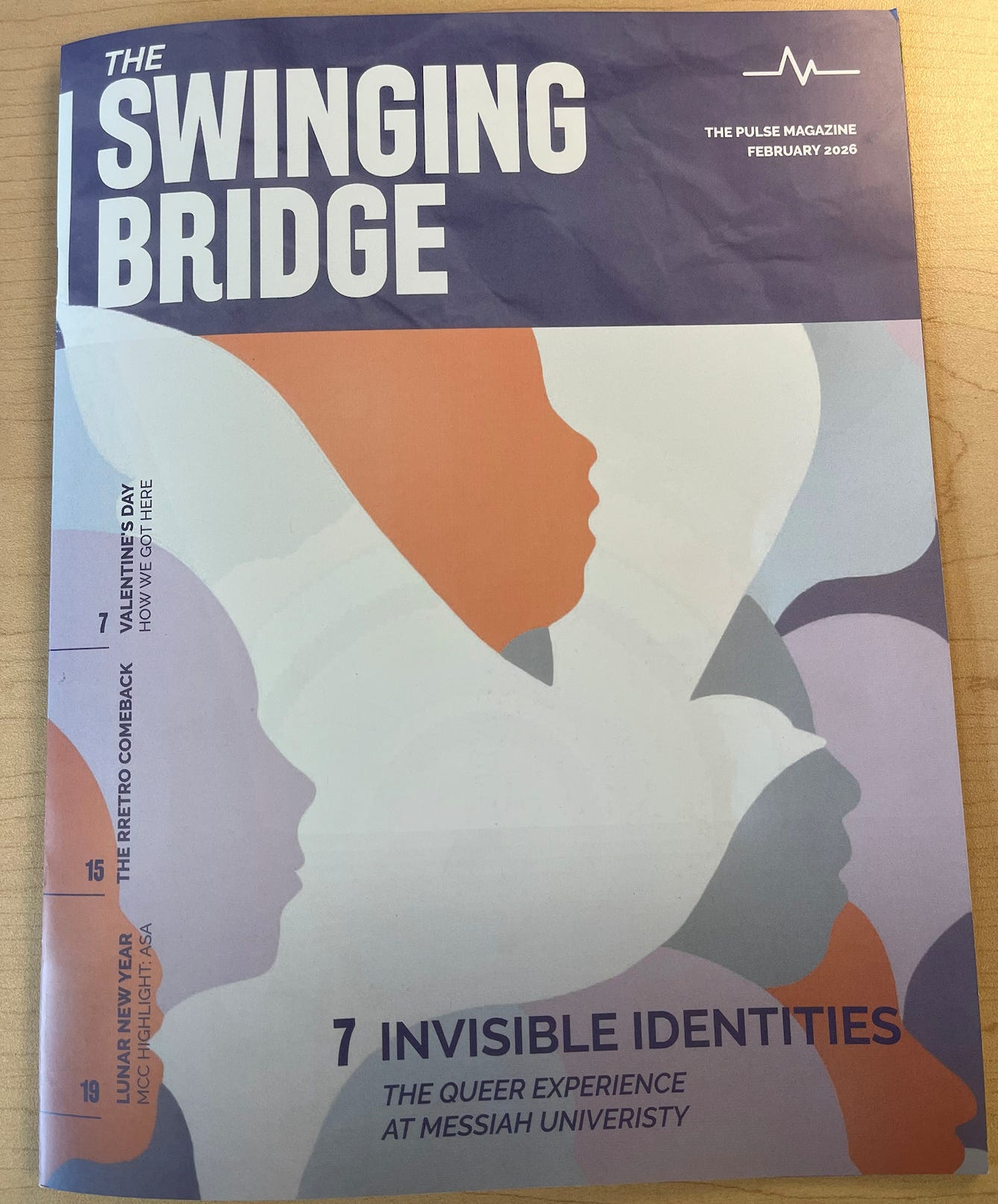
“Invisible Identities: The Queer Experience at Messiah University”
The February 2026 issue ran a six-page feature titled "Invisible Identities: The Queer Experience at Messiah University." It opened with this premise: "Although the exact number of queer students at Messiah University is unknown, several students have felt that the current policies regarding same-sex relationships and queer identities have negatively impacted their time on campus." From that premise, the piece interviewed students and alumni who felt harmed by Messiah's commitment to historic Christian sexual ethics, with no defense from any alumni who appreciate the institution's courage to hold clearly and faithfully to Scripture. It presented one side of a serious debate under the guise of journalism.
(I have placed a PDF of the article at the bottom of this piece so you can read it in full)
That has compelled me to share what the magazine chose not to: the heart behind Messiah’s adherence to faithful Christian views on marriage, sex, and family. And to be clear, I am not writing as an outsider.
I enrolled at Messiah in the fall of 2009. I played on the men’s soccer team, met my wife, studied cross-cultural Christian ministry, and had some of the best years of my life on that campus. The faculty challenged me in the way good educators should: rigorously, charitably, and with genuine attention to more than one side of difficult theological questions. We try to make it back to campus at least once a year. I have always been proud to call myself a Messiah alum.
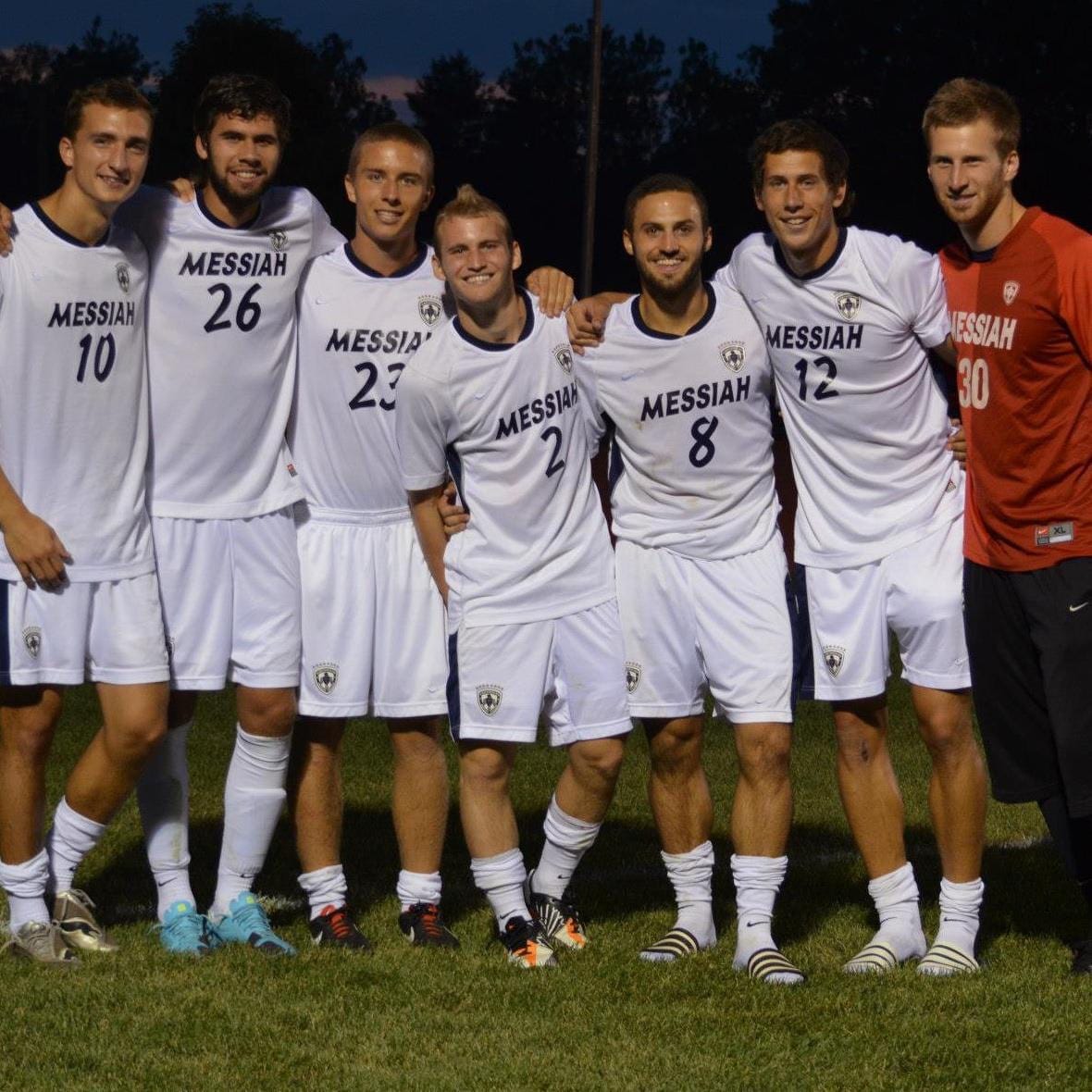
What follows is not the work of someone who wishes Messiah harm. It is the work of someone who loves the institution and believes this issue deserves a stronger defense than it received.
First, a Word of Appreciation
President Stuckey deserves credit for his clarity. Asked directly about Messiah’s position on marriage and human sexuality, he stated: “As a Christian university, Messiah University holds to beliefs and practices that are rooted in our humble understanding of scriptural teaching and the historic teaching of the Christian church, both broadly and of our founding denomination the Brethren in Christ Church. Accordingly, the university affirms Christian marriage to be the union of one man and one woman, and that all human sexuality should be understood within this framework.”
That clarity is the bare minimum we should expect from a Christian institution. It is a sad commentary on today’s landscape that holding the line, plainly and without apology, in the face of coordinated activist pressure has become notable. But it is notable, and it is right, and Messiah’s leadership deserves to be affirmed for it.
It is also worth noting what Messiah has done beyond holding the line. The University’s Student Handbook is more welcoming than many Christian colleges on the question of orientation itself, stating plainly:
“It is important to note that Messiah University’s behavioral expectations are related to same-sex sexual expression, not orientation. The University does not hold the view that it is morally unacceptable to experience same-sex attraction or to identify as LGBT+.”
A student who struggles with same-sex attraction and lives faithfully within Messiah’s covenant standards faces no discipline, no diminishment of standing, no exclusion from campus life. The university’s position appears to be that the struggle is not the sin, and that students navigating it deserve pastoral care rather than condemnation.
That pastoral posture extends even to behavioral violations. Dean of Students Doug Wood clarified that a breach of Messiah’s intimacy standards does not result in removal from enrollment. “It’s done in the context of care and counseling and support, as opposed to a formal disciplinary hearing,” Wood said. “So it is done with great care.” Taking even this posture of leniency and pastoral understanding has earned Messiah criticism from those who believe the university should draw a harder line, particularly on its decision to permit students to openly “identify” as LGBT+ while only restricting same-sex sexual expression. That debate is real and justified. But my point here is this: by any reasonable standard, Messiah has gone above and beyond to accommodate a minority constituency on its campus, and the article still paints it as not enough.
To that end, the university has also previously offered SAGE, Sexuality and Gender Education, described officially as an educational program that “exists to provide opportunities for enhanced care and support for students while cultivating learning and leadership development within the broad themes of relationships, sexuality, and gender rooted in Messiah’s biblical understanding.” SAGE operated under the Division of Student Success and Engagement. From outward appearances, it did claim to be an affirmation group of LGBTQ+ identity. That distinction is precisely why the article portrays it as falling short.
Read the article carefully and you find the real disagreement surfacing in the students’ own words. One recent alumna, Ella Shane, expressed dismay at the widespread belief that if you’re queer, you cannot actually be Christian, and that on Messiah’s campus, not being Christian is “pretty much the worst thing you can do.” Another, Alex Hay, declared: “I do believe I was intentionally made by God, and that means my trans-ness and my queerness was made intentionally.” These are not complaints about being excluded from campus life. They are theological assertions. They are claiming that their identity is doctrinally correct and that Messiah’s position is doctrinally wrong. That is not a problem any amount of pastoral care, SAGE programming, or gracious policy language can solve.
The finish line is not tolerance. The goal is affirmation and celebration of a belief the Christian church has historically never held.
One recent alum, AJ Jerome, made this explicit. Jerome declared that the board of trustees should “answer to the fact that they are actively hurting people” because they “can’t get over the fact that God can love people that aren’t straight, and aren’t cis, and that their God might be a little bit bigger than what they thought God was.” That quote was printed in a university-funded publication without editorial comment. It does not ask for kindness. It tells the board of a Christian institution that their theology is threatening. Complete capitulation is the only outcome that will satisfy. Anything less is recast as “oppression”.
On the Question of Motive
The article then goes on to present, without qualification or challenge, the accusation that Messiah’s convictions on marriage and gender are financially motivated; driven not by genuine theological conviction but by donor pressure. The alum making the accusation, identified as JJ, had himself served in a leadership position on the Student Government Association, at a time when, by his own account, the SGA had a majority queer cabinet. His full statement is worth reading:
“At some point in my leadership position, [Student Government Association] had a majority queer cabinet. But we all knew that a change in policy is far from anything this institution will be able to accomplish in the near future. I’ve found out that there is very little we could do when the people who hold all the power threaten with their money.”
Threaten with their money.
Read that carefully. A student who held significant institutional influence, whose cabinet reflected the movement’s priorities, who had genuine access to advocate for change, concluded that the reason policy didn’t move was financial intimidation. President Stuckey explicitly and emphatically denied it. The article printed both the accusation and the denial— then offered no analysis, no evidence, no journalistic accountability. That is not balance. That is the mask of neutrality used to legitimize a smear.
Imputing the motives of deeply religious people, people whose institution has held a consistent theological position for over a century, rooted in a denomination whose convictions long predate this cultural moment, is a remarkable editorial choice. To print it without comment is not brave journalism. It is cowardice parading in the costume of fairness.
What We Actually Believe, and Why It Matters
The Gospel is good and true. Good for humanity, for families, for children, and for society. True in a world that increasingly tells us it is not. We do not hold these positions because a rulebook demands it. We hold them because we are convicted of their Truth in a world that calls them false, and their goodness in a world that does not seek our flourishing. This is not robotic obligation. We defend them from a place of passionate conviction.
The Gospel makes claims about reality. Not just spiritual reality, but human reality. What we are. How we are made. What we need. What families are for. What children deserve. These are not religious preferences layered over a neutral world. They are descriptions of how things actually are. And when the world began insisting, with increasing aggression and intolerance, that biological reality itself was negotiable, that sex was fluid, marriage was outdated, and parenthood assignable at birth, those of us who knew the Gospel recognized the lies immediately.
What I did not expect, when I was a student at Messiah, was that I would one day have to argue for the reality of biological sex and the meaning of marriage, motherhood, and fatherhood as if these were debatable philosophical opinions rather than observable facts. Let alone that abandoning those convictions would be repackaged as faithful Christianity.
Take sex first. The belief that God created human beings male and female is the unanimous teaching of the Christian church for more than two thousand years, rooted in Genesis and reaffirmed across every major Christian tradition in every century of the Church’s existence. The article argues that queer people have “existed for all of recorded history.” Well, so has the Church’s unbroken consensus on this question. If longevity is evidence, the scales do not tip the way the article implies.
But the defense of biological sex is not only theological. It is urgently pro-child. We are living through a period in which young children are being told that their sense of unease with their bodies constitutes a medical identity requiring pharmaceutical and surgical intervention. Puberty blockers suppress normal development. Cross-sex hormones administered in adolescence cause documented risks of permanent infertility. Double mastectomies on young girls. These are not hypothetical concerns raised by ideologues. They are documented medical realities now under serious re-examination in the United Kingdom, Sweden, Finland, and Denmark, all of which have restricted or reversed the pediatric gender medicine protocols that until recently had been expanding rapidly in the United States. To hold that children deserve protection from irreversible interventions is not hatred. It is the most basic form of child advocacy.
Now take marriage. Marriage between a man and a woman is not an arbitrary religious preference. It is the only relationship that unites the two people whose biology is required to create a child. Every child ever born is the offspring of one man and one woman. One sperm, one egg. That biological fact creates a bond as real and observable as the child’s sex. The reason virtually every human civilization has recognized some version of this institution is not bigotry. It is the recognition that children need, belong to, and have a right to the two people who made them.
This understanding did not collapse all at once. Christians failed to defend their definition of marriage in big ways and small— in the pulpit, in the classroom, and in the coffeeshop; in the quiet accommodation of divorce and cohabitation; and in a thousand other concessions that slowly detached marriage from its Christian definition and biological logic long before any court touched it. The Supreme Court did not create the opening. It walked through the door we left open.
In Obergefell v. Hodges (2015), the Court extended to same-sex couples the full “constellation of benefits” that marriage confers. One of those benefits is the “right” to become a parent. Previously, this was the recognition of the biological bond between Mothers/Fathers and their children. The centuries-old understanding that a married couple’s union produced children and those children have a right to both of them. But in the wake of the ruling, same-sex couples faced an unavoidable biological reality: two men or two women cannot create children. Extending “equal” access to children, therefore, required a new answer to who a child’s parents are. To say their biological Mother and Father (as we always have), excluded Same Sex couples. So, the the law arrived at a new answer: parents are no longer recognized by biology, they are assigned by intent (I’ve written more about that here). In today’s world, whoever intends to parent, whoever contracts for it, pays for it, wants it badly enough, is declared the winner (parent). The child’s actual biological mother or father is sidelined, compensated, and erased from the birth certificate.
This new legal fiction, Parent Assigned at Birth, requires sperm to be purchased, eggs to be sold, women’s bodies to be rented through surrogacy contracts, and children to lose their mother, father, or both so that unrelated adults who cannot be their biological parents are able to get what they want: a child.
We believe that is an injustice. Not because the adults who form these families are bad people, but because a child’s right to be known and raised by their own mother and father does not disappear because adult desire is intense or love is genuine. The child’s loss is real regardless of the quality of the home they are placed in. That is the true cost of affirming adult desires and identities at the expense of biological reality.
We believe this position to be both scientific and moral: neither your sex nor your parents can be assigned at birth. Both are encoded in your DNA. You can take a blood test and learn your biological sex. You can take that same test and identify your mother and your father.
The decision Messiah is being asked to make is not between donor money or compassion. It is between adult desires and children’s rights.
You may believe that biological sex is fluid. You may believe that marriage can be between any two, three, or five people. You may even believe that children have no particular right to be raised by their own biological mother and father, that any two adults the state assigns are equally sufficient, that the biological bond between a parent and child is a sentimental preference rather than a scientific reality. These are all positions people hold. That is your right. But to treat convictions held by the global Christian church since its founding as rooted in animus, homophobia, or greed, is a tired play.
It is 2026, we are done having our ancient beliefs blamed for threatening people’s existence. The children harmed by the outcomes of these ideas deserve better.
A Final Word
The Swinging Bridge asked its readers to see these students as victims: victims of an institution that refuses to fully affirm their identities, victims of a theological tradition that will not bend.
Affirm us, or you are the oppressor. But affirmation has a cost, and it is not a bill that will be paid by the adults demanding it. Affirming gender ideology means endorsing the medical interventions described above. Affirming the redefinition of marriage, and as a result parenthood, means endorsing a marketplace in which children are intentionally separated from their biological mother or father by contract. This is the choice being forced: will we deny Christian teaching or remain faithful to it?
These students are not the victims.
Families, kids, and our culture will inherit the consequences of decisions being made right now in our classrooms, courtrooms, hospitals, and legislatures.
We advocate for a Gospel-centered understanding of life, marriage, sex, and family because we believe it is God’s best for everyone. We believe it leads to flourishing.
We will not apologize for defending it.
-JW

About the Author:
Currently, I serve as the Executive Director of Them Before Us, advocating globally for the rights and well-being of children.
I am also the co-founder of All The Good, a leadership organization helping non-profits do all the good they are called to do.
I studied Cross-Cultural Ministry and Humanitarian and Disaster Leadership at Messiah and Wheaton. I read a lot and sleep less than I probably should.
My wife and I live in Charlotte, North Carolina with our 4 kids.

As a fellow Messiah alum, thank you for speaking biblical truth with clarity and courage.
Wish our Christian institutions had leaders capable of articulating these issues as clearly as you did here.