
St. Thomas: The Sarcastic Disciple.
What we can all learn from exhausted honesty
I was reading through John’s Gospel this past week, going slowly enough to actually stop at things I’d blown past a hundred times, when I landed on a line from Thomas that I’d somehow never really heard before. Not the “doubting” line. A different one.
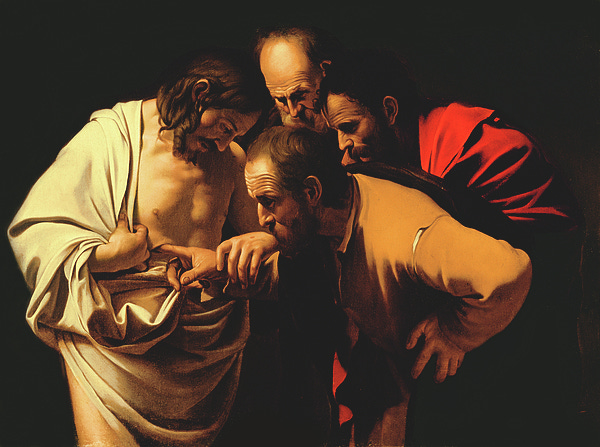
Jesus announces to the group that they’re going back to Judea, where people had recently tried to stone him, and the disciples are protesting, and then Thomas turns to the group and says: “Let’s go, too—and die with Jesus.” (John 11:16b)
Wait a second. Die? What is Thomas talking about? I thought they were going to heal Lazarus? Why is Thomas talking about dying?
Examining the Eye-Roll:
To really understand the significance of Thomas’ line: “Let’s go, too—and die with Jesus” you need to back a chapter and pull out a map. A few pages earlier, Jesus and the disciples fled Jerusalem to go across the Jordan River, completely outside the Religious elite’s immediate reach. They’re not hiding exactly, but they’re definitely intentionally out of range. Then word comes that their friend Lazarus is dying, and Lazarus lives in Bethany, roughly two miles from Jerusalem’s city gates. Two miles from the people who just tried to kill Jesus.
So when Jesus says they’re going back, the disciples push back immediately: Rabbi, they were just now seeking to stone you, and are you going there again? Jesus tells them Lazarus has fallen asleep and he needs to go wake him. The disciples, grasping at any reading of the situation that doesn’t end in their collective funeral, suggest that if Lazarus is just sleeping then there’s no need to walk back into a kill zone. Jesus stops them and just says it bluntly: Lazarus has died.
And then Thomas turns to the group with the energy of a man who has run out of counterarguments: “Let’s go, too—and die with Jesus” Alright. Might as well go get killed too.
You can almost hear a sigh… or picture an eye roll. I didn’t catch it on my first read but with context it begins to sound like some kind of reluctant dark humor. As I reflected on the line more, I began to see that this kind of sarcasm is really what honesty looks like when it's tired. Thomas isn't projecting courage he doesn't actually have… he's just grown too weary to dress it up.
This passage is a moment in the story where we truly understand how the disciples were seeing the situation. They weren’t confused about the danger. They were scared, and they knew exactly why (they had seen the stones). Thomas just said it out loud while everyone else quietly hoped someone would talk Jesus out of it. His willingness to think out loud gave all of us an added layer to the story. Jesus was risking his life and the lives of others by traveling to the region. And in his own unique way, Thomas’ obedience in the face of that danger (however comically) is a fresh look at the story.
It made me curious to reexamine other places where Thomas speaks in the Gospels. It turns out it is a short list. He is only mentioned in passing in the first three, and quoted in John only 4 times. However, after looking at his other three quotes — I am convinced we owe him a lot more respect and admiration than is normally given to the “doubting disciple”. His honesty unlocks some of the most insightful and quoted passages of the entire Bible.
The Next Question.
The second time Thomas speaks is the Last Supper, John 14. Jesus is telling the disciples he’s going to prepare a place for them and that they know the way to where he’s going. Most of the disciples apparently let this pass, not Thomas.
“Lord, we do not know where you are going. How can we know the way?”
It was a literal, honest question… and you know what? I think everyone in that room was probably thinking the same thing; Thomas was the only one willing to say so.
And Jesus responds not with gentleness but with one of the most foundational statements in all of Scripture: I am the way, the truth, and the life. No one comes to the Father except through me.
Thomas’s refusal to pretend he understood pulled that answer out into the open, honesty calling forth clarity in return. One of the most quoted verses in the Bible exists because one disciple was willing to admit he was lost and was unafraid to look stupid.
The Doubt.
The third and fourth quotes come together in John 20. Thomas hasn’t seen the risen Jesus. Ten disciples tell him they have. He won’t move. “Unless I see the nail marks and place my hand into his side, I will never believe.”
People read this as failure. Maybe John does, but notice that Thomas still doesn’t leave. He’s still there, still in the room with the disciples, eight days later when Jesus appears specifically for him. The most stubborn man gets the most personal appearance of the risen Christ, a scene Christians struggling to hold on to their faith have resonated with for centuries.
It is during this encounter that Thomas says six syllables that most commentators on John agree are the theological summit of the entire Gospel: “My Lord and my God.” He offered nothing else, no speech, no explanation, no hedging: that’s who you are.
What makes those words so striking is where John places them. He opens his Gospel with the declaration that Jesus is God, “the Word was God,” and then spends twenty chapters showing us a group of ordinary people slowly, awkwardly at times, trying to figure out who exactly they are following. Thomas’s confession at the end answers the opening line of the book. The slowest one to come around finally says out loud what John told us on page one. That is not an accident. John built the whole Gospel toward this moment, and he gave it to Thomas.
And don’t miss what those words cost:
To a Jewish listener, declaring a man to be God was blasphemy, the precise charge that had the religious leaders reaching for stones back in John 10. Thomas knows this. He has been in those conversations. He says it anyway.
To a Roman ear the problem was different and equally lethal. “My Lord and my God” was the formal divine title of the Emperor. That was Caesar’s phrase, Caesar’s claim. Thomas looks at a Jewish carpenter who just came back from the dead and hands the Emperor’s title to him instead. John’s first readers would have felt the collision immediately, because one of those claims has to be wrong, and in occupied territory, choosing the wrong one could get you killed. For many early Christians it did.
Thomas went from the dark humor of “let’s go die with him” to a remarkable confession that impacted the world. You can trust his sincerity precisely because you have watched him consistently refuse to say anything he didn’t mean (and to always say all the things he does).
Failing Forward.
God always does his best work through the honest, the broken, and the willing. He doesn’t ever seem to need us to have it figured out first. Some of the greatest lessons in the Gospels didn’t come from the disciples having it all figured out. They came from them collectively working it out, as we follow along. Thomas refused to pretend or fake understanding. He let us watch him think out loud. We should all be grateful that he did.
About the Author:
Currently, I serve as the Executive Director of Them Before Us, advocating globally for the rights and well-being of children.
I am also the co-founder of All The Good, a leadership organization helping non-profits do all the good they are called to do.
I studied Cross-Cultural Ministry and Humanitarian and Disaster Leadership at Messiah and Wheaton. I read a lot and sleep less than I probably should.
My wife and I live in Charlotte, North Carolina with our 4 kids.


