


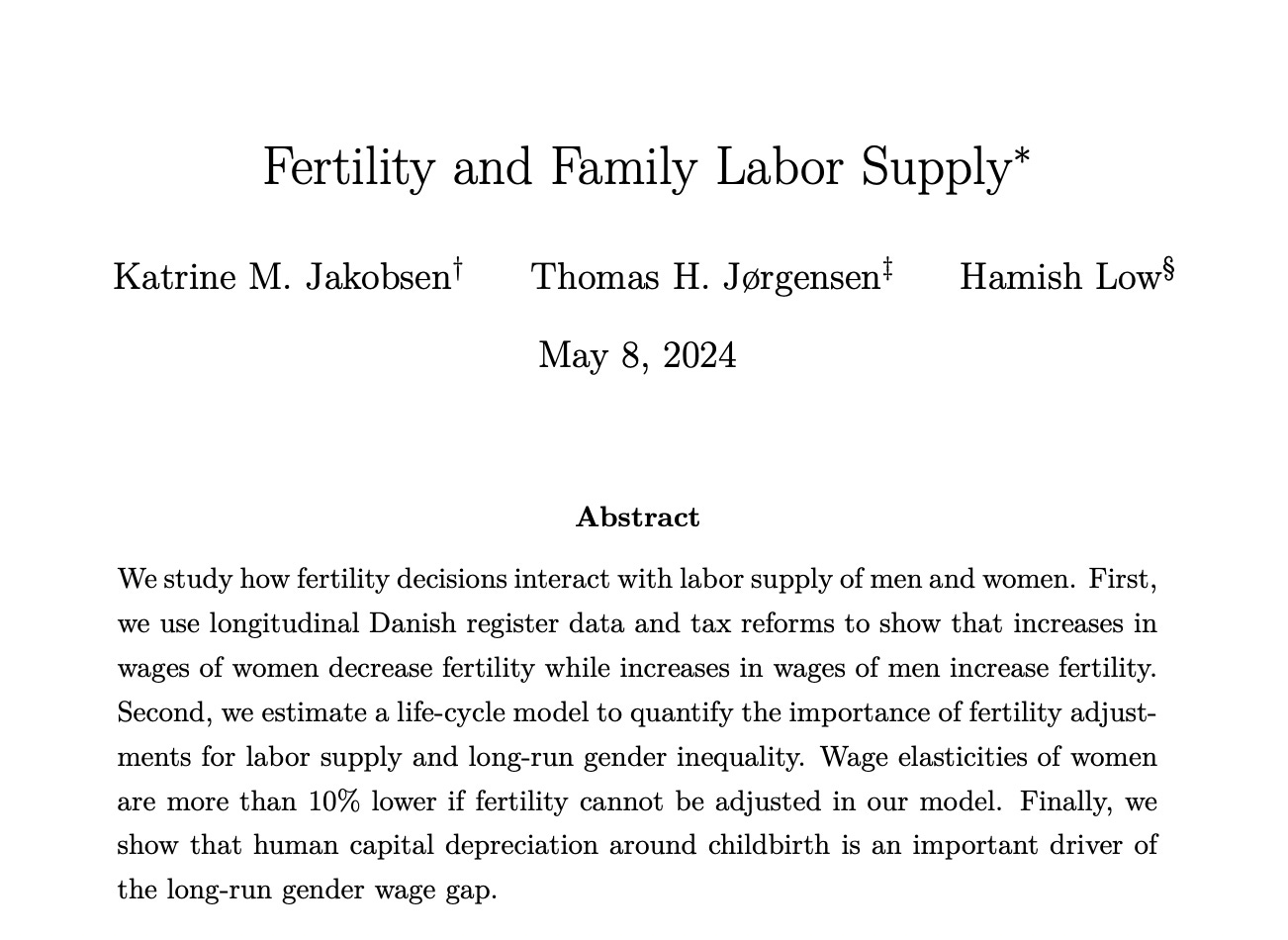
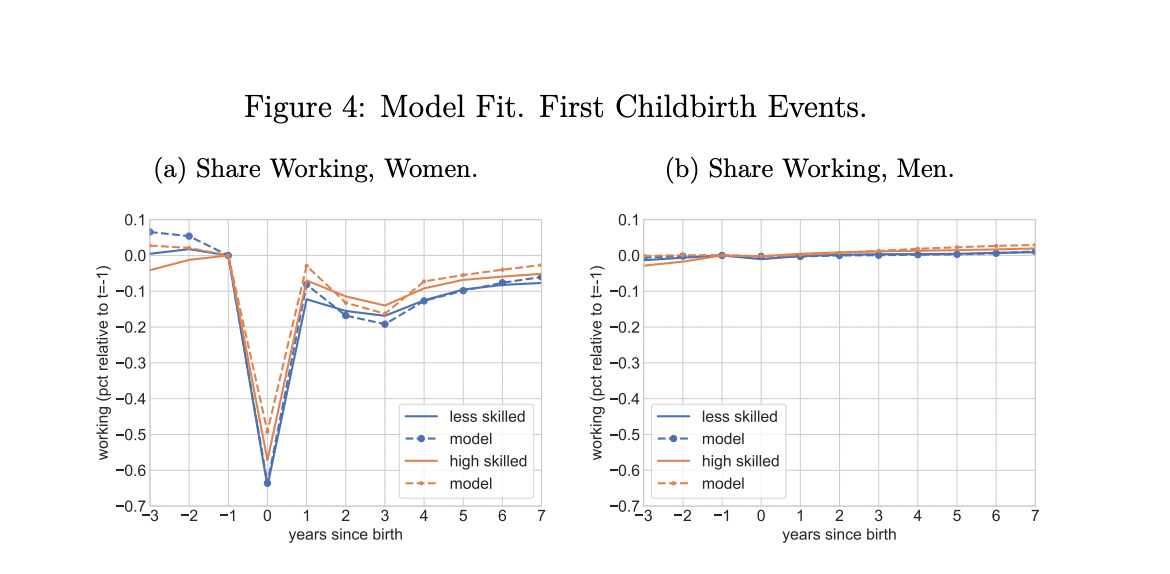
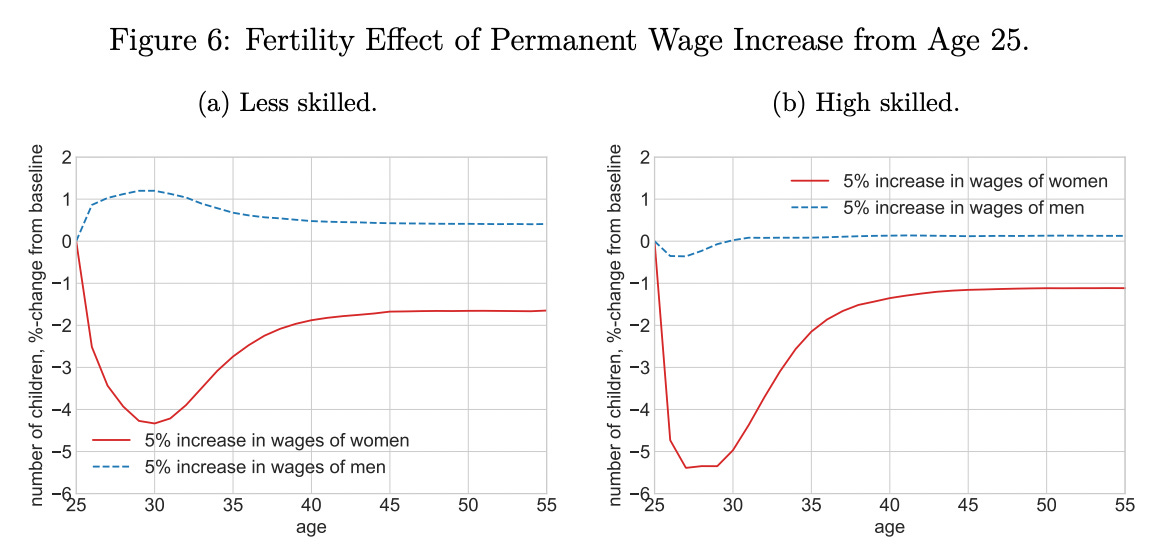
A December 2025 working paper from the Federal Reserve Bank of Chicago has laid bare a choice that most policymakers, pundits, and cultural commentators refuse to acknowledge. The paper, “Fertility and Family Labor Supply,” by Jakobsen, Jørgensen, and Low, uses decades of Danish register data to demonstrate something that should stop us in our tracks: when women’s wages rise, fertility falls. When men’s wages rise, fertility increases.
This isn’t a finding from a conservative think tank. It’s from the Chicago Fed, using data from Denmark, one of the most progressive, gender-egalitarian nations on earth. And it doesn’t just describe a pattern. It reveals a mechanism. Women’s time is the irreducible currency of motherhood. The more that time is worth in the marketplace, the more expensive children become. Not in dollars, but in opportunity. No subsidy, no policy, no program has been able to neutralize this trade-off. Not in Scandinavia. Not anywhere.
The paper also finds that human capital depreciation—the way a mother’s professional skills, workplace networks, and earnings trajectory erode during time away from the labor market—is an important driver of the long-run gender wage gap, explaining about a quarter of the persistent gap between men’s and women’s earnings. Motherhood is not just temporarily costly. It compounds.
Put these findings together, and you arrive at a fork in the road. Two fundamentally different visions of human flourishing, each with its own logic, its own appeal, and its own inevitable destination.
Before We Get to the Fork: The Denmark Problem
At this point, a reasonable person might object: the problem isn’t structural. It’s that we simply haven’t built enough support. If we had better parental leave, affordable childcare, and a real safety net, women wouldn’t face such a brutal trade-off between career and children. The mechanism the Chicago Fed describes is real, the argument goes, but it can be overcome with the right policy architecture.
This is a fair objection. It’s also one that Denmark has answered decisively, by building exactly the system this argument calls for. And fertility is still falling.
Consider what Denmark actually offers parents. Each parent receives 24 weeks of paid parental leave after the birth of a child, a combined 52 weeks total, with the option to extend parental leave from 32 to 46 weeks. For workers, 11 of those 24 weeks are non-transferable, specifically designed to encourage paternal involvement. Childcare is available from the age of 26 weeks, with the state subsidizing at least 75 percent of the cost. Every child in Denmark is guaranteed a spot in municipal daycare by law. Low-income families pay nothing. According to 2021 OECD data, a couple in Denmark spends roughly 9 percent of household income on childcare, compared to over 22 percent in the United Kingdom and even more in the United States.
But it doesn’t stop there. Healthcare is universal and free at the point of service, including all maternity and pediatric care. Education is free from primary school through university, and students receive government grants while enrolled. Families receive a quarterly child allowance for every child under 18. Housing subsidies are available for eligible families. The “flexicurity” labor model means that even if a parent loses a job, robust unemployment benefits and retraining programs prevent economic freefall.
Denmark is not a country that has neglected family support. It is arguably the most family-supportive policy environment ever constructed. And its total fertility rate is approximately 1.5 children per woman, well below the 2.1 replacement level needed to sustain a population. It peaked at 1.9 in 2010 and has fallen by 22 percent since. Even a recent Ms. Magazine article acknowledged that Denmark’s policies only offset about 80 percent of the “motherhood penalty” and that remaining 20 percent is apparently enough to keep fertility below replacement indefinitely.
The Nordic countries as a whole tell the same story. Finland, with a similar welfare architecture, has fallen to a TFR of 1.25, the lowest in its history, lower than at any point since record-keeping began in 1776. Sweden is at 1.43. Norway at 1.44. Iceland hit a record low in 2024. These are the countries that took the “just build more support” hypothesis most seriously, invested most heavily, and still cannot produce enough children to replace their own populations.
This is not an argument against parental leave or subsidized childcare. These are good things that help families. But they are not sufficient to solve the fertility crisis, because the crisis is not primarily a policy problem. It’s a structural one. The Chicago Fed data tells us why: the mechanism that suppresses fertility (the rising opportunity cost of women’s time) operates at a level that policy supports can cushion but cannot reverse. Denmark has proven that you can build the most generous safety net in human history and still not reach replacement fertility.
With that established, we arrive at the actual fork in the road. Not “should we have better policy?” but “which fundamental vision of society will we organize around?”
Road One: The Egalitarian Individual
The first road is the one the Western world has been building for half a century. Its core commitment is to the economic equality and autonomy of the individual, regardless of sex. On this road, the goal is to minimize the differences between men’s and women’s economic lives. Women should earn what men earn, work where men work, and never be penalized, economically or socially, for their biology.
This road has produced extraordinary gains. Women are more educated than ever. Female labor force participation has transformed economies. The gender wage gap, measured crudely, has narrowed. For millions of women, this road has meant freedom, dignity, and opportunity that previous generations could not have imagined.
But this road has a destination, and the Chicago Fed data helps us see it clearly.
If the primary project is to increase women’s individual earning power and labor market attachment, then fertility will continue to decline. Not because women are selfish. Not because policy has failed. But because the mechanism is structural: the more a woman’s hour is worth in the marketplace, the more each child costs her. The substitution effect (the economist’s term for the rising price of her time) overwhelms whatever subsidies, leave policies, or childcare programs are layered on top.
Every nation that has traveled furthest down this road confirms it. South Korea, with massive government investment in pro-natal policy totaling over $270 billion since 2006, recorded a total fertility rate of just 0.75 in 2024, the lowest of any OECD nation. Japan, Singapore, Italy, Spain: all have pursued some version of “support women in the workforce AND hope they have babies,” and all are watching their populations begin to disappear.
The logical end of this road is not mysterious. It is a society of highly productive, highly autonomous individuals who do not replace themselves. The economy hums for a generation, maybe two, then begins to buckle under the weight of an inverted age pyramid: too many elderly, too few young. Immigration can delay the math but cannot solve it, because immigrants assimilate to the same fertility-suppressing incentive structure within a generation.
At the terminus of Road One, you get a civilization that is rich, aging, contracting, and eventually unable to sustain its own infrastructure, pensions, or defense. You get a society that liberated the individual from the obligations of family and then discovered, too late, that the family was the engine of the future.
The cruelest irony is that this road also fails women on its own terms. The gender wage gap, as the paper shows, is primarily a motherhood gap driven by human capital depreciation. The women who do have children on Road One bear the full economic penalty in a system designed around uninterrupted individual productivity. The system doesn’t accommodate motherhood. It punishes it, and then calls the punishment a “gap” to be closed by making women behave more like men.
Road Two: The Complementary Family
The second road starts from a different premise. It takes the Chicago Fed data at face value and asks: what if men and women are not interchangeable economic units, but complementary ones? What if the institution that channels male earning power toward sustaining a family, while freeing women to invest their irreplaceable time in children, is not a relic of patriarchy but a rational, pro-child, pro-woman structure?
This is the road of marriage. Not marriage as mere sentiment or ceremony, but marriage as an economic and social architecture designed around a biological reality: children need their mother’s time in ways that are intensive, prolonged, and not fully substitutable, and someone has to underwrite that time economically.
The data supports this directly. When men earn more, fertility rises, because male income functions as household wealth that doesn’t trigger the substitution effect on women’s time. A husband’s raise doesn’t make his wife’s hours more expensive. It makes the family more secure. It is the one economic input that the data shows actually supports fertility without the corresponding suppression.
Road Two requires a fundamentally different set of investments. Rather than maximizing female labor force participation, it prioritizes household economic viability on a single or primary income. Rather than treating the wage gap as an injustice to be eliminated, it recognizes the gap as evidence that mothers are doing something valuable that the market doesn’t price. Rather than building ever-larger childcare systems to get women back to work faster, it asks whether the goal should be to make it possible for women to be with their children without economic ruin.
This road is culturally unfashionable. It will be called regressive. But its destination is a society that actually has a next generation.
The logical end of Road Two is a civilization that grows, or at least sustains itself. Where the default assumption is that families are the fundamental unit of society, not individuals. Where tax policy, housing policy, and labor policy are built around making it viable for one parent to be home, not as a quaint throwback but as a strategic investment in human capital—the small kind, the kind that packs lunches for school and reads bedtime stories and eventually grows up to fund your Social Security.
Road Two is not without costs. Women who invest years in caregiving are economically vulnerable if marriages fail, which means this road demands a legal and cultural framework that takes marital commitment seriously. Not as a trap, but as a covenant that protects the person who made the bigger sacrifice. It means fathers have to be present and provider-oriented, not optional. It means society has to say, out loud, that motherhood is not a lesser vocation.
The Wrong Lens
But here is what troubles me about everything I’ve written so far: it’s all still trapped inside the economic frame. And that frame is part of the problem. If you accept that human life is best measured in wages, productivity, and opportunity cost, then the Chicago Fed paper makes fertility look like a sacrifice. Road One is the rational path for the individual. Road Two is the dutiful path for civilization. That framing is a lie. Not because the economics are wrong, but because the economics are measuring the wrong things.
The data on what actually makes for a good life tells a very different story than the one our culture is selling. Brad Wilcox, a sociologist at the University of Virginia and director of the National Marriage Project, has spent decades studying what predicts human happiness and flourishing. His findings, drawn from the General Social Survey, the University of Chicago’s research on well-being, and a joint study with the Wheatley Institute, are remarkably consistent: marriage is the single strongest predictor of happiness in America. Stronger than income. Stronger than education. Stronger than career satisfaction. Married men and women are nearly twice as likely to report being “very happy” as their unmarried peers.
And it’s not just marriage in the abstract. The 2022 General Social Survey found that 40 percent of married mothers between the ages of 18 and 55 reported being “very happy” with their lives, the highest of any group. Married mothers were more likely than any other group of women to say their lives felt meaningful most or all of the time. They reported higher levels of purpose, connection, and physical affection.
But here is the part that matters most for the argument: unmarried women without children reported being “very happy” at a rate of 22 percent. And unmarried mothers? Just 17 percent, the lowest of any group. Read that again. Women who had children outside of marriage were less happy than women who had no children at all. Children alone do not produce flourishing. What produces flourishing is children within the structure of marriage: a husband who is present and committed, a covenant that makes the sacrifice mutual, a partnership designed around the reality that raising children is too important and too demanding to do without the stability and dependability of someone doing it with you.
The data is not telling us that kids are the answer. It is telling us that marriage is the design, and children are the fruit.
The costs of choosing against this design are deferred. They don’t show up on a pay stub at 32. They show up in the data at 55. University of Chicago economist Sam Peltzman has found that the decline in marriage is the primary statistical explanation for the decline in American happiness. The things we were told would make us happy, autonomy, career achievement, freedom from obligation, have coincided with the most anxious, medicated, and lonely generation in American history.
To be clear: this is not a claim that every person who does not build a family lives a meaningless life. Many people live with purpose and joy outside of marriage and parenthood. But a civilization that treats children as a lifestyle accessory rather than its central mission, one that penalizes having and raising them instead of honoring the sacrifice, is not a civilization that will exist for very long. And even setting aside the civilizational math, the data says most people who do build families are glad they did.
Children are not an economic cost to be minimized. They are the point. Marriage is not a constraint on freedom. It is the structure within which freedom finds its meaning. The economic frame cannot see this because it has no variable for joy, no coefficient for purpose, and no regression that captures what it feels like to be needed by someone who shares your blood and your name.
The Choice We Refuse to Name
We are standing at a crossroads, but it’s deeper than policy. It’s deeper than economics. It is a question about what we believe human beings are for. The Chicago Fed measured wages and labor supply and found that men and women respond to economic incentives in opposite, complementary ways. Brad Wilcox measured happiness and meaning and found that marriage and parenthood are where human beings actually flourish. The data from both directions points to the same destination:
The family is not an obstacle to the good life. It is the good life. And the institution that makes it work, that protects mothers, channels fathers, and gives children what they need, is marriage.
The nations that have chosen individual economic optimization are not happier. They are richer and lonelier and disappearing. The math doesn’t care about our preferences. But neither does the human heart, which keeps longing for exactly the things our economic models told it to abandon. The question is not whether we can afford to have children. It’s whether we can afford the emptiness of the alternative, and whether we’ll discover the answer before the choice is made for us.
-JW
About the Author:
Currently, I serve as the Executive Director of Them Before Us, advocating globally for the rights and well-being of children.
I am also the co-founder of All The Good, a leadership organization helping non-profits do all the good they are called to do.
I studied Cross-Cultural Ministry and Humanitarian and Disaster Leadership at Messiah and Wheaton. I read a lot and sleep less than I probably should.
My wife and I live in Charlotte, North Carolina with our 4 kids.

Great article with supportive data! I think one important piece to this is how God intended the role of men and women. God as the foundation creates sustainable and deeply centered marriages. Not necessarily happy marriages. That word happy is overrated in my opinion. You can't sustain happiness but you can sustain peace. Husband and wife both have such important, different jobs in the home. Women are led to believe submission is something degrading, when really it's something that can be beautiful when shared with a husband who as you said is present and committed. Whose every action and purpose is to lift his family. For a woman to be given that space of vulnerability is a treasure. Cultural christianity is replacing theological doctrine. I would say Road 3: Western Cultural Christianity. This road leads to greater influence of cohabitation and less influence over covenant marriage. Marriage is symbolic, not so much sacred. Personal happiness sometimes becomes the highest value.
This is excellent. It has always bothered me that we try to quantify absolutely everything in economic terms. Money cannot replace some things—least of all a warm, thriving, close-knit family.