
Cosplay Christianity.
The Church's growing discipleship problem
Last week a new survey started making the rounds and Christian leaders went into full alarm mode. Compiled by FRC/Barna, the study showed that churchgoing Americans identifying as pro-life dropped 20 points in two years.
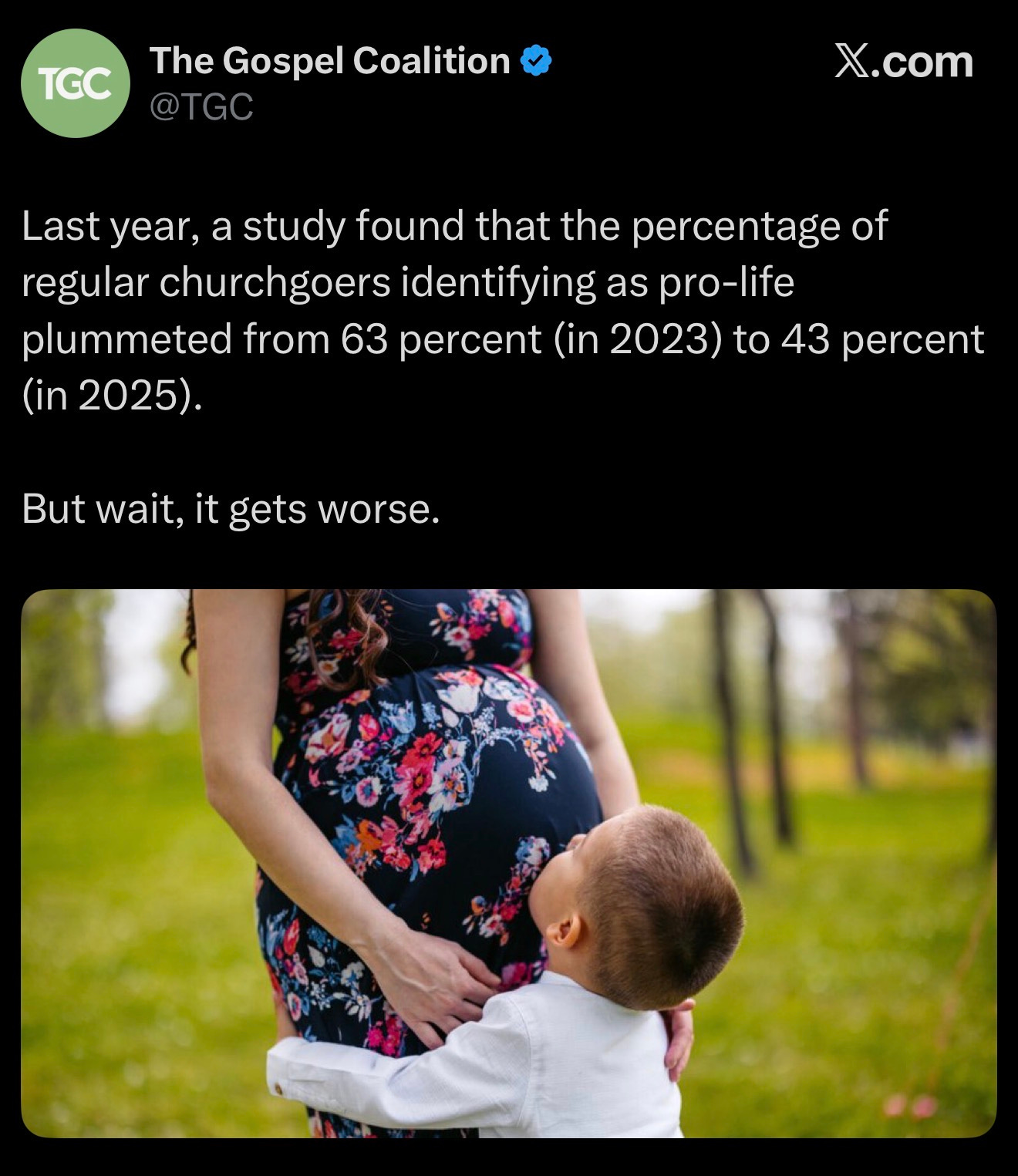
There were lots of opinions:
"Christianity is collapsing"
"The pro-life movement is losing the church"
"Culture is winning"
But before I fell prey to the hysterics, I wanted to look at the data.
I’m not surprised by what I found.
The headline shouldn’t read: “Christians abandoning the pro-life movement” It should read, “Study of casual churchgoers found spectators sitting in the pews.”
Big difference.
Who Was Actually Surveyed
The FRC Center for Biblical Worldview, directed by George Barna, surveyed adults who attend a Christian church at least once a month — including online. No doctrinal test. No faith commitment required. Show up once a month and you qualify. This is an updated version of the same study conducted in 2023, repeated in 2025 for comparison.
Shockingly, 15% of respondents were NOT Christian by their own description — Jewish, Muslim, Buddhist, Mormon, or no faith identity at all. Up from 14% in 2023.
I am not saying that’s disqualifying for the data, after all, THEY do go to church (whatever that means). But WOW that should make us pause before we draw sweeping conclusions about the state of Christianity in America.
Theology Dropped First
Here’s what the panic missed. Before you get to the social issue numbers, look at what happened to the theological ones.
Between 2023 and 2025, every single foundational theological marker moved in the wrong direction:
• Orthodox view of God: 68% → 61%
• Biblical salvation through Christ alone: 47% → 36%
• Human condition as sinful by nature: 41% → 31%
• Purpose of life as knowing and serving God: 53% → 37%
• Success defined as obedience to God: 39% → 25%
Every single one. Wrong direction.
Then watch what followed:
• Pro-life identification: 63% → 43%
• Bible clear and decisive on abortion: 65% → 51%
• Bible clear and decisive on marriage: 75% → 65%
• Bible clear and decisive on homosexuality: 63% → 47%
Theology dropped first. Social positions followed — almost point for point.
RIGHT THINKING. RIGHT ACTION.
WRONG THINKING. WRONG ACTION.
What Weak Theology Produces
When your worldview is not informed by the Bible, you had better believe it will be informed by something. There is no neutral. Culture fills the vacuum. And culture will always push you toward unbiblical social positions.
GK Chesterton has a famous quote for just this situation:
“What is the good of words if they aren’t important enough to quarrel over? Why do we choose one word more than another if there isn’t any difference between them? If you called a woman a chimpanzee instead of an angel, wouldn’t there be a quarrel about a word? If you’re not going to argue about words, what are you going to argue about? Are you going to convey your meaning to me by moving your ears? The Church and the heresies always used to fight about words, because they are the only thing worth fighting about.”
The Positive Case
The survey offered one clear encouraging proof point for the other side of the argument.
Among those surveyed, a specific group stood out — people who engage regularly with Scripture, deeply committed to practicing their faith through participation at church, and invested enough that it has moved them into active civic life. People for whom Christianity isn’t a spectator sport.
When asked what informed their social positions, 100% said the Bible. Not their party, not the culture, not their feelings. Every single one went to Scripture.
Among those who weren’t engaged with their faith? Just 38%.
We don’t have a Bible problem. The Word hasn’t lost its power. When people genuinely engage with it (when they sit under real teaching, participate in real community, and let their faith move them to action) the Lord is faithful to transform.
The Gospel still works. It always has.
The Real Question
So, did this survey capture an unusually nominal slice of churchgoers?
Or are we staring at a discipleship crisis that runs deeper than we want to admit?
Either way one pattern is undeniable, when theology erodes and people disengage, social positions drift.
Lukewarm Christianity will not win the cultural moment we are in. Surface-level faith, the kind that shows up (or tunes in) once a month and calls itself a churchgoer, produces exactly the slide we see in this survey.
The Church won’t be successful because more seats are filled. We will win when congregations are being challenged, held accountable, and continually pushed to actually apply what Scripture says. Pastors who preach the hard things. Communities that expect more than attendance. Faith that costs something.
Maybe it’s time we stopped measuring church health by how many seats we fill and started measuring it by how faithfully the people in those seats are living out God’s truth.
Casual spectators were never the goal.
Disciples are.
About the Author:
Currently, I serve as the Executive Director of Them Before Us, advocating globally for the rights and well-being of children.
I am also the co-founder of All The Good, a leadership organization helping non-profits do all the good they are called to do.
I studied Cross-Cultural Ministry and Humanitarian and Disaster Leadership at Messiah and Wheaton. I read a lot and sleep less than I probably should.
My wife and I live in Charlotte, North Carolina with our 4 kids.


