


In case you’ve somehow missed it, last month, a former Cornell student filed a lawsuit against the university and seven former fraternity brothers.
A commentator I listened to this weekend, Michael Smerconish, summed it up: “Repugnant, yes. Criminal, maybe. Provable, doubtful.”
Repugnant is the easy part.
She told police she was “super drunk when I got there. ... But I was pretty OK with all of this,” referencing an initial threesome. But as Smerconish noted, “consent to one act does not establish consent to everything that follows.” As the night wore on, more drugs and alcohol followed. In the chapter’s group chat, one brother asked, “Shop still open?” Another wrote, “Boys come whip it out.” Several men are alleged to have raped her.
Provable is harder.
Days later, she texted one of the men that “At the end of the day non [sic] of the sexual stuff was illegal and honestly I really liked being with u.” She even proposed smoking with him again, “but like leave out the extra 5 billion men and ketamine.”
Around the same time, she texted the friend who had invited her to the house: “Bro, everyone knows.” The night was “RUINING my life temporarily,” she wrote, and all she could do was “sleep and cry all day.” When he told her she didn’t have “anything to be ashamed of,” she answered, “You’re right. It’ll get better.” (The texts come from Cornell’s Title IX file, reported by The New York Times.)
Two weeks after that, she wrote that “90% of what happened that night was not consensual.” Later, in her police interview, she said, “I can say with 100% confidence I was raped.”
Criminal is where the specifics of law come in.
New York apparently has a “voluntary intoxication loophole.” Under New York law, being drunk or high only makes you “mentally incapacitated” if someone gave you the drugs or alcohol without your consent. Opponents of changing the law argue it is hard to pin down “the exact point at which a person becomes too drunk to consent.” According to the district attorney, her original statement described taking the drugs herself. The district attorney concluded it did not describe a crime, even while calling the men’s behavior “disgusting and morally reprehensible.” The case has since been reopened, and the governor has handed it to a special prosecutor.
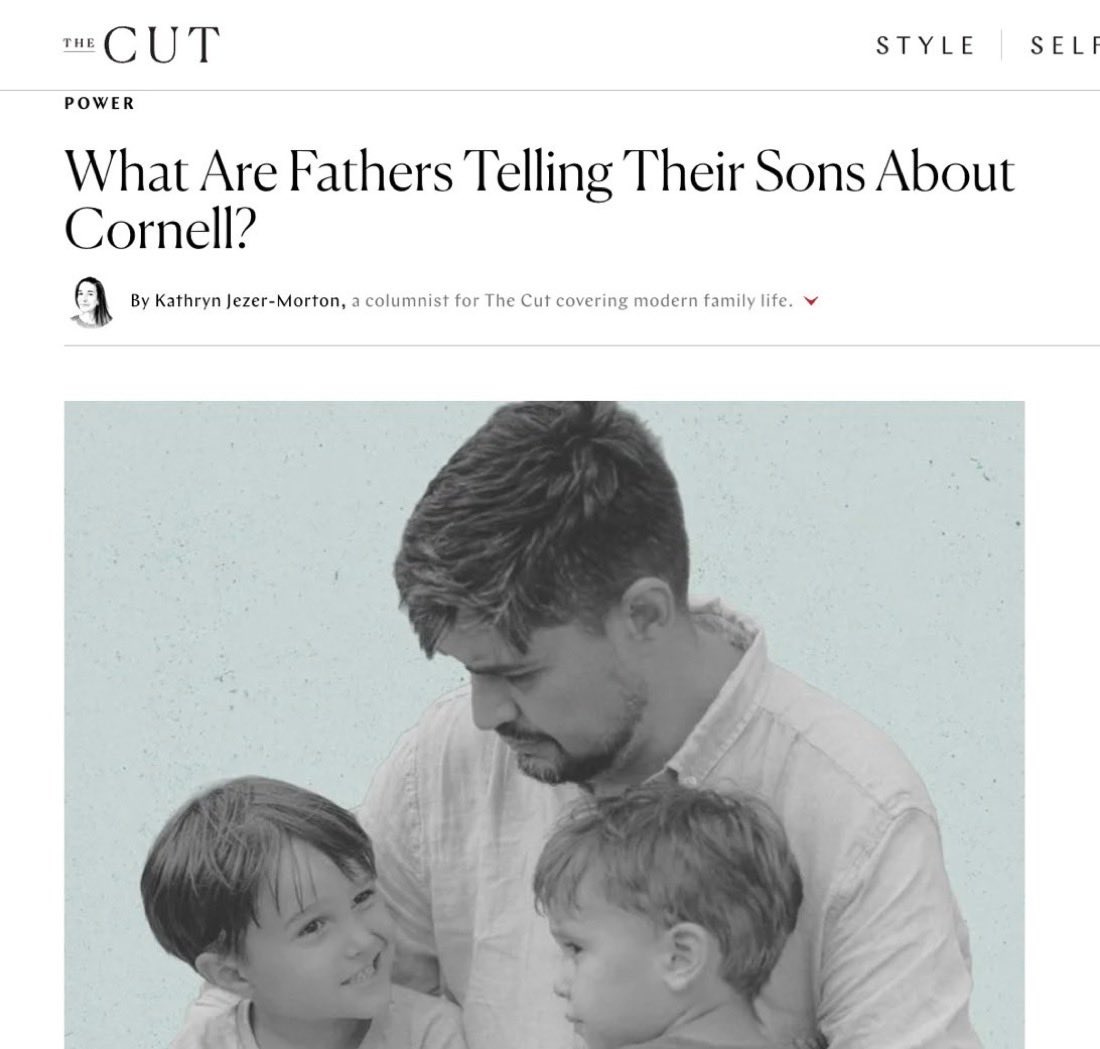
So when I saw a headline this week from New York Magazine: “What Are Fathers Telling Their Sons About Cornell?” it made me think, if I was giving advice in hopes of preventing future situations like this, what would I say?
I believe the situation at Cornell (and others like it) exposes the poverty of a sexual ethic built almost entirely around consent.
We have told young people that sex can be easily detached from marriage, permanence, fidelity, children, responsibility, even love, and that as long as everyone says yes, the encounter is morally legitimate.
That leaves women with an impoverished set of categories afterward. If a sexual experience leaves her feeling ashamed, degraded, used, or disgusted, our culture gives her very little language for saying: I consented, but it was still wrong. I participated in something that was bad for me.
Instead, the options increasingly become: it was liberation, or it was rape.
But there is a third category: consensual sexual behavior can still be degrading, exploitative, reckless, and morally destructive.
Consent matters because sexual coercion or assault is a grave violation of another person. No person has the right to force themselves on another, exploit their impairment or incapacity, or use their body against their will. But the absence of coercion or assault does not make a sexual act good.
Consent establishes a floor, not a moral vision.
It tells us when a boundary has been violated; it cannot tell us what sex is for, where it belongs, or what men and women owe one another before, during, and after it.
Marriage can.
Marriage does not treat sex as a free-floating act whose morality is determined only by whether two or more people consent in the moment. It reserves sex for a specific context because sex is powerful, consequential, and sacred.
Before the sexual act, a man and woman stand before their families, their community, and God and make a public, lifelong commitment to one another. That commitment gives sex its proper purpose, perspective, and protection. Sex then becomes not merely something two people agree to do, but the bodily expression of a covenant they have already made: fidelity, permanence, mutual obligation, and openness to the children their union can create.
That framework asks much more of a man than, “Did she say yes?”
It asks:
Have you promised yourself to her?
Will you remain faithful to her?
Will you accept responsibility for the children sex may create?
Will you still be there tomorrow, next year, and fifty years from now?
Marriage offers a richer sexual ethic. It says consent is necessary, but it is not enough.
Sex belongs inside a covenant strong enough to bear its meaning, its potential, its vulnerability, and its consequences.
That is what I want my sons to understand.
The goal is not merely to become men who can secure consent.
It is to become men worthy of making, and keeping, the kind of promise that gives sex its proper home.
ABOUT THE AUTHOR:
Currently, I serve as the Executive Director of Them Before Us, advocating globally for the rights and well-being of children.
I am also the co-founder of All The Good, a leadership organization helping non-profits do all the good they are called to do.
I studied Cross-Cultural Ministry and Humanitarian and Disaster Leadership at Messiah and Wheaton. I read a lot and sleep less than I probably should.

Powerful! And absolutely TRUE!
Brilliantly said.