


I saw an article this week from the Daily Mail, written by Inge van Lotringen, under a crazy headline: “The reason I look so good? I don’t have children.” Now, she said that she expected a pile-on, and truthfully, I think she deserves it.
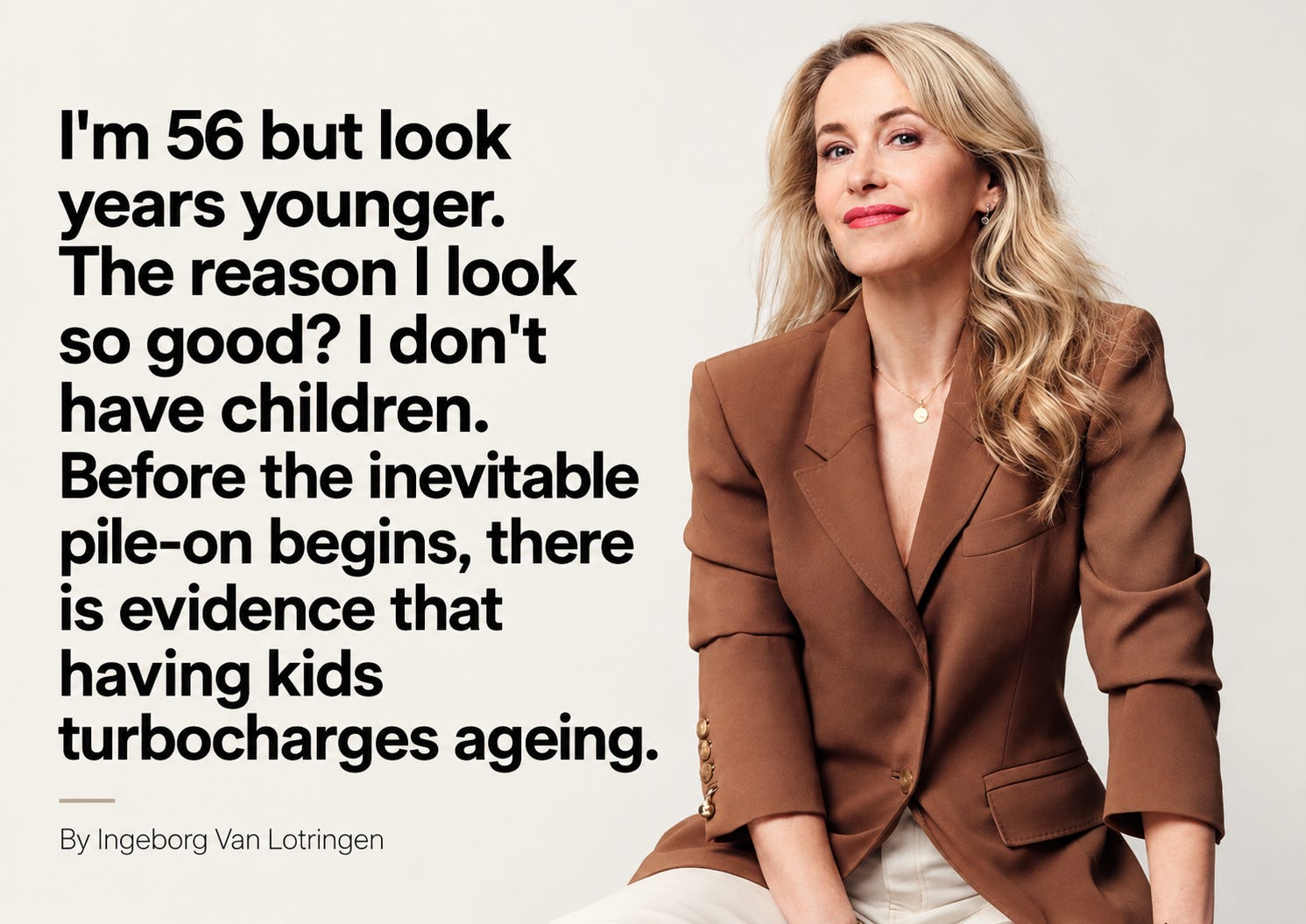
Within days, the Daily Mail’s post of the article already had a Community Note pointing to a University of Helsinki study published this year. Researchers in that study followed 14,836 Finnish women, all twins, and they actually found that women with two or three children had the slowest biological aging and the lowest mortality risk. Pretty incredible, but I don’t want to dismiss the underlying motives of this article that quickly. People keep publishing things like this because they resonate with a certain audience. Let’s take a second to look at what she’s trying to get at.
Buried beneath the surface is truly a claim about what life is for: a belief that the purpose of life is to arrive at your last few decades showing the least amount of wear. If children take a massive toll on your body, then they should be avoided at all costs.
Now, look, no parent who has spent a decade chasing toddlers is going to lie to you and say it’s easy. We all know it’s taxing: from body changes to sleep deprivation, the mounting expenses, the loss of time with your spouse, it can be a lot, but it can also be a lot of fun. In it, we find a strange paradox (kind of like the gospel, right? More on that later) where it can be all of those difficult things and inexplicably joyful, fulfilling, and meaningful. Don’t take my word for it, though. It’s all backed up by data.
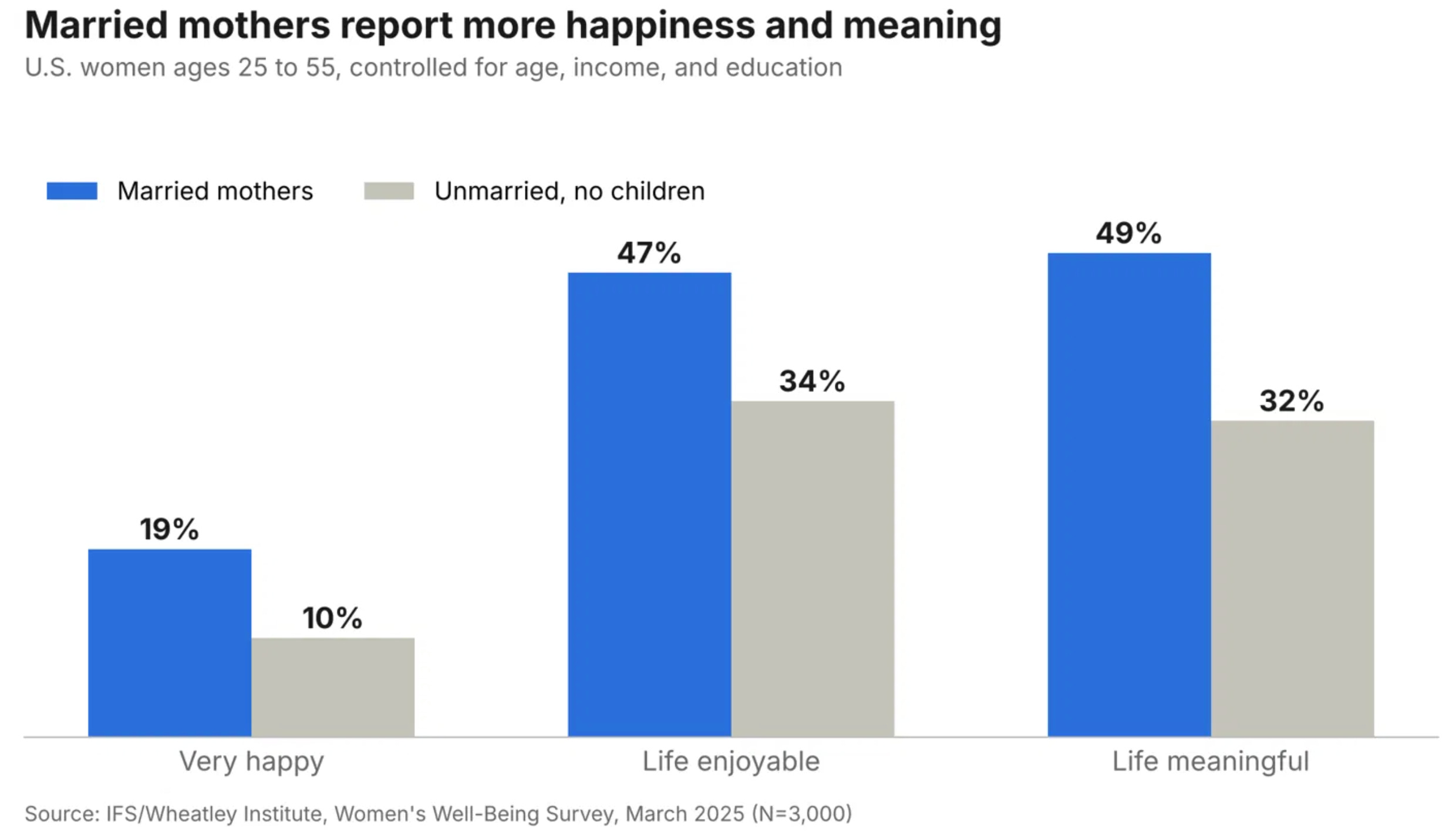
According to a 2025 Institute for Family Studies and Wheatley Institute survey, married mothers are nearly twice as likely as single women without children to say they're very happy, and far more likely to say their lives feel meaningful. Yes, mothers also report more daily strain. They report more happiness at the same time.
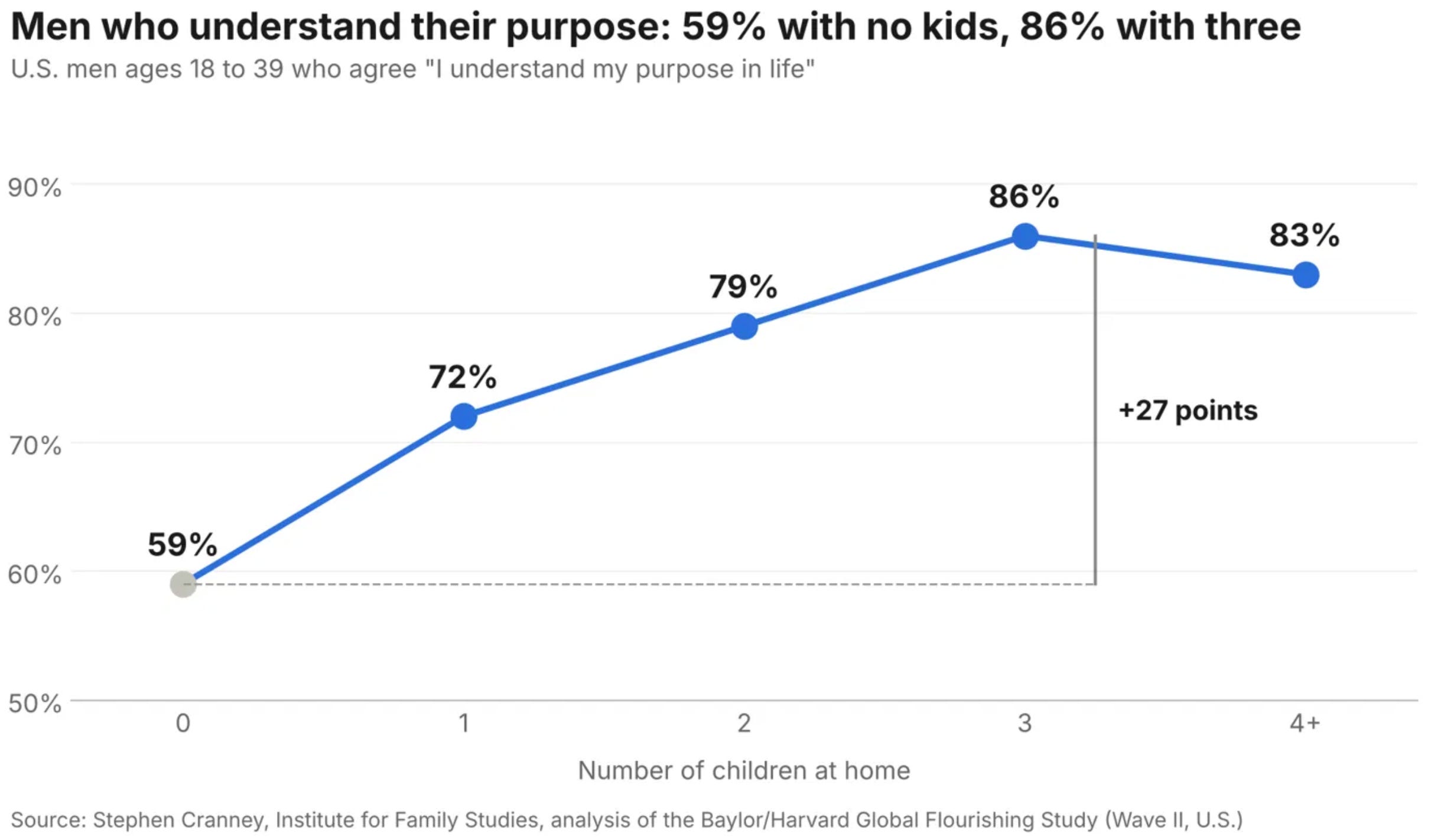
Men show the same pattern. In an IFS analysis of the Baylor/Harvard Global Flourishing Study, 59% of men under 40 without kids say they understand their purpose in life. With three kids, it's 86%.
What’s incredible is that, in spite of these well-publicized and repeated numbers, the culture has done an effective job pushing this anti-child, inward-focused propaganda, and sometimes it seems like they are winning. In my discouragement, I’m sometimes tempted to believe that this poisonous trend is something insidious and new. It can be helpful at times like this to take a step back and look for a historical perspective.
Enter The Velveteen Rabbit.

As I was reading that Daily Mail article, I immediately thought of a frame hanging in my daughter’s bedroom with a quote from that wonderful book. The funny thing about children’s books is the wisdom they communicate isn’t just for kids. The best ones resonate over centuries because they contain timeless truth and because they effectively combat generational lies.
The Velveteen Rabbit has been in print for over 100 years. Not only is it widely regarded as one of the best children’s books of all time, but it’s also one of my family’s personal favorites. I am not ashamed to admit that I have gotten emotional while reading it with my own children. The story truly is powerful.
In case you’ve never read the book, a boy receives a velveteen rabbit for Christmas. He’s quickly forgotten in the nursery, where the fancier mechanical toys look down on him, and the only one kind to him is the oldest toy, the Skin Horse (very creepy name). Then one night, when the Boy’s favorite toy goes missing at bedtime, the Rabbit is rediscovered as a substitute, and the Boy comes to love him so hard that he’s worn apart.
Early in the story, the Rabbit asks the Skin Horse what it means to be Real. The answer he gets is this: “Real isn’t how you are made. It’s a thing that happens to you. When a child loves you for a long, long time, not just to play with, but REALLY loves you, then you become Real.”
The book goes on to explain who it rarely happens to, and what it costs: “That’s why it doesn’t happen often to people who break easily, or have sharp edges, or who have to be carefully kept. Generally, by the time you are Real, most of your hair has been loved off, and your eyes drop out and you get loose in the joints and very shabby.”
The book tells us the Rabbit "wished that he could become it without these uncomfortable things happening to him." I think that's the same wish behind the Daily Mail column, and it raises the same question: What are we made for?
Van Lotringen would have you believe that her face is a testimony to the benefits of not having children. In the words of the Skin Horse, she’s been “carefully kept.” Her flawless skin, she believes, makes her real. She’s happy in her article to list exactly what it takes to be real like her. Beyond skipping children, she talks about HRT, Botox, a £4,500 collagen injection, a £7,000 eyelid lift, and a regular routine that’s more than £5,000 a year.
She also claims one of the benefits of this real life is the freedom to “selfishly imagine we’re still 25 and worry about nothing but ourselves and each other.” This worldview is a small window into a much larger philosophy, one where the self is treated as a thing to be prioritized and protected at all costs.
But it’s not just contained to the Daily Mail. It can also be seen in the biohacking and hyper-health-conscious movement.
This was put on full display back in August when Bryan Johnson was interviewed by Ross Douthat about his “Don’t Die” philosophy. In case you don’t know, he’s basically spending millions of dollars researching how he can reverse his aging and maybe try to live forever.
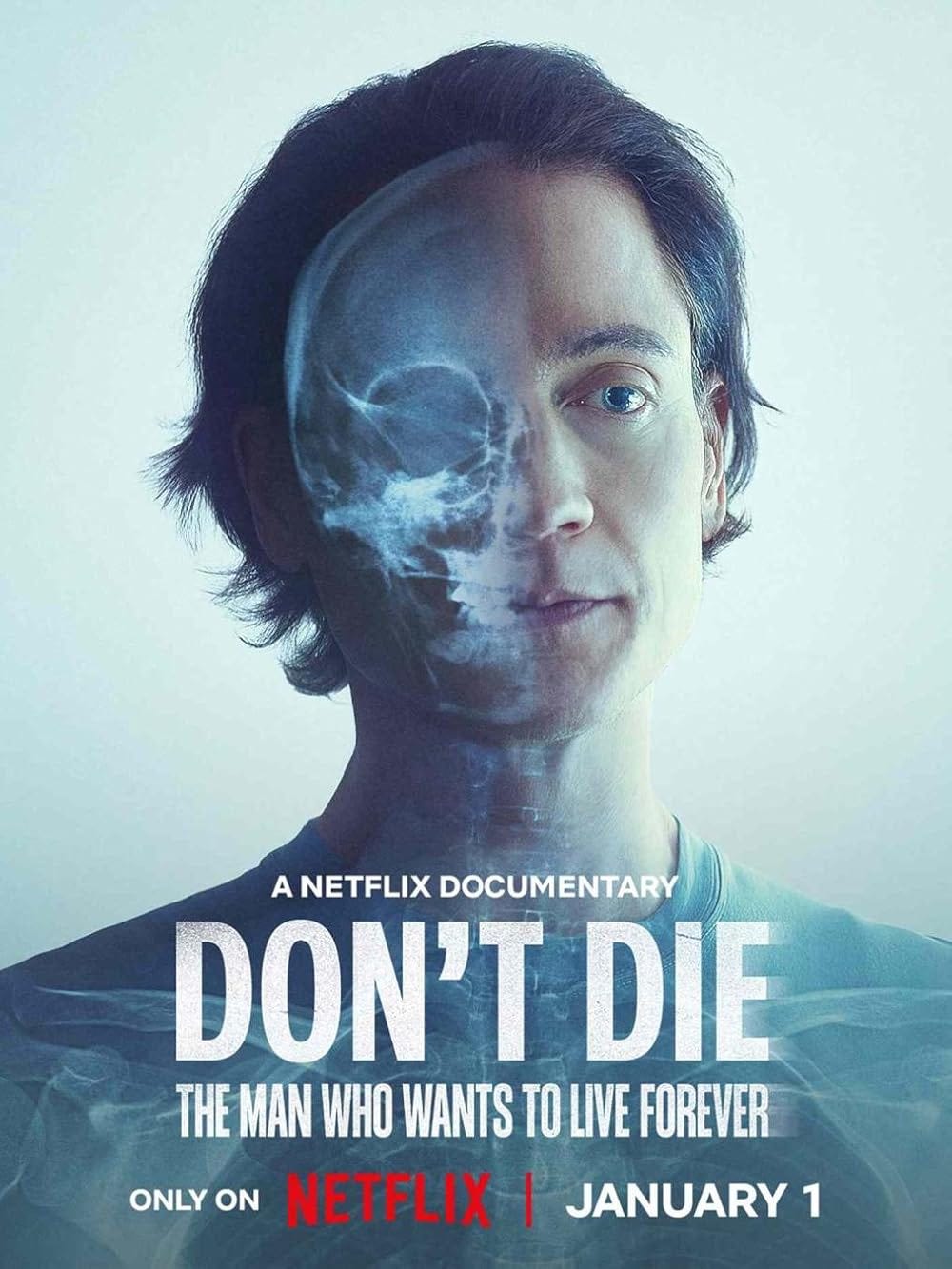
What was fascinating is that, by the end of the interview, Johnson ascended into a pseudo-spiritual state, telling Douthat that the highest expression of virtue is for humanity to “preserve intelligent life above all other objectives.” Again, the ideology of self-preservation as the highest good.
Douthat, as he is known to do, answered one worldview with an ancient perspective that was diametrically opposed. Quoting Jesus in John 15, he pointed to the words, “Greater love has no one than this, that someone lay down his life for his friends.” He noted that sacrifice has historically meant a willingness to risk death so others may live. We see it when women undergo childbirth, when men go off to war. Poignantly, he then asked, “What are you willing to die for, Bryan?”
Johnson didn’t answer. In fact, Johnson can’t answer because, fundamentally, at the core of his worldview is an inward-focused ideology, one where the greatest love is a love of self, and where the contemplation of sacrifice for another would be a betrayal of one’s own potential. This may play well in Silicon Valley or Davos, but placed alongside the selflessness of Christ’s declaration, it looks intellectually anemic.
Douthat added, “I don’t think death is good. I’m against death, but I think being willing to die is good.”
Douthat was essentially preaching the gospel, pointing at its paradox. Jesus says in Matthew 16: “Whoever loses his life for my sake will find it.”
The Velveteen Rabbit ends on the same paradox. When the Boy comes down with scarlet fever, the Rabbit stays with him in his bed through the whole illness. But once the Boy recovers, the doctor orders the Rabbit burned with the rest of the germ-covered toys. Lying in a sack waiting for the bonfire, the Rabbit asks, “Of what use was it to be loved and lose one’s beauty and become Real if it all ended like this?” He cries a real tear, and where it falls, a flower grows, and a fairy steps out who takes the toys children have loved once they’re old and worn out and makes them Real. She turns him into a living rabbit, Real to everyone at last. It’s hard not to read it as a picture of what waits for a life spent on a worthy cause. Or, as the Skin Horse put it, “once you are Real you can’t become unreal again. It lasts for always.”
As Christians, we know what we do looks crazy to the outside world. Our Scripture teaches us that our wisdom will look like folly to those who are perishing. From our sexual ethic to our desire to put our lives on the line for our children, it runs counter to everything this Daily Mail article and biohacker stand for.
This is why The Velveteen Rabbit has so much to teach us. Becoming Real always requires self-giving love. The Rabbit’s sense of worth was found at the very moment he lost himself. The Boy “loved him so hard that he loved all his whiskers off,” and the Rabbit “scarcely looked like a rabbit any more, except to the Boy. To him he was always beautiful, and that was all that the little Rabbit cared about.”
As parents — it is our tired eyes, dented walls, and messy cars that scream out as evidence of the love we’ve endured. The world needs the testimony of the lines on a mother’s face, the gray in a father’s beard, and the aching joints that come from years of carrying our children forward.
This is what we are made for.
This is what gives life meaning.
I just pray you get the privilege of finding out.
ABOUT THE AUTHOR:
Currently, I serve as the Executive Director of Them Before Us, advocating globally for the rights and well-being of children.
I am also the co-founder of All The Good, a leadership organization helping non-profits do all the good they are called to do.
I studied Cross-Cultural Ministry and Humanitarian and Disaster Leadership at Messiah and Wheaton. I read a lot and sleep less than I probably should.

Now I am glad I can still tell his story
All so good! Profound. Deep. Amazing. Loved that story. Such great comparisons to Jesus. We tried to have children. I wish we did. Wish that I could have had one from my hubby. My hubby served and loved like the rabbit. Like Jesus. He was a happy servant! He is whole and free and with Jesus. Wish he was still here. I am glad he’s real. They both are real.