
Can the Government love YOUR neighbor?
A Three-Part Series on Jesus, Money, and the State
I was scrolling through social media the other day when I came across a post criticizing the government for cutting benefits programs and reshaping our foreign aid.
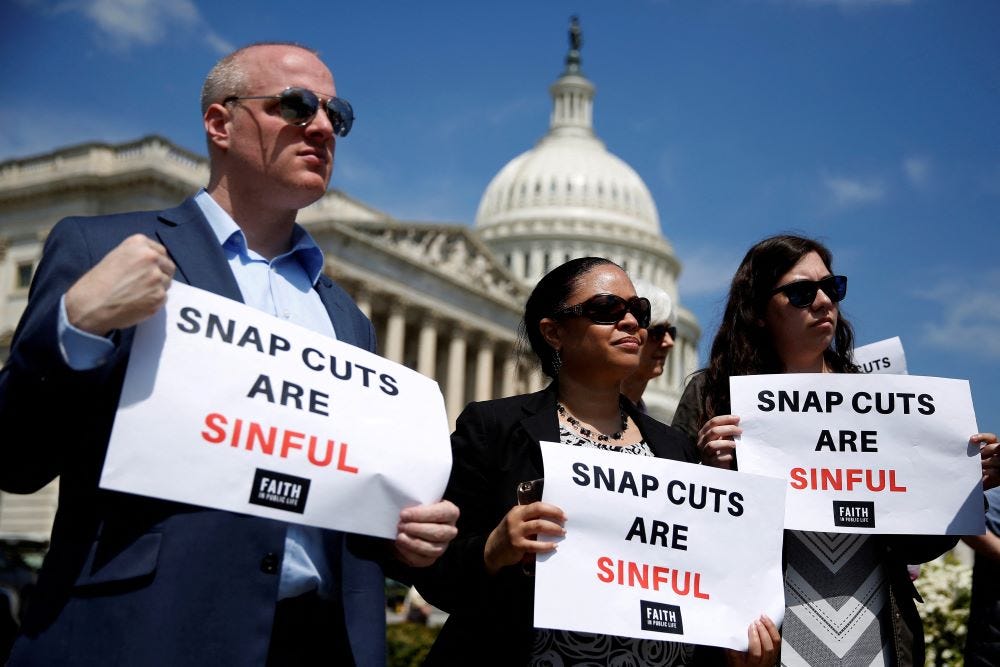
There has been a lot of this lately:
“SNAP cuts are sinful. Jesus was a refugee. USAID saves lives.”
Moral outrage about everything from international aid cuts, rollbacks on healthcare, escalating immigration enforcement, all of it framed in moral and religious language.
I came across one post in particular: “Jesus wants us to feed the poor—they obliterate aid. Jesus wants us to care for the sick-they attack affordable healthcare. Jesus wants us to befriend the imprisoned—they criminalize our neighbors. What good is their Christianity if it looks nothing like Christ?”
My response, if you can’t see the screenshots: “The Good Samaritan used his own money. The widow gave her own mite. The early church sold their own possessions. Voting to tax your neighbor isn’t sacrifice. It’s outsourcing obedience.”
I meant it. But I was blown away by comments, positive and negative. People are genuinely divided on this. So I decided to do dive in to the topic further. My goal was to better understand all sides involved in this issue, especially how Jesus saw it (if that’s possible). This led me to narrow my scope to three questions:
What was Jesus’ approach to money and helping the poor, and did he ever assign that responsibility to government?
What is the government’s legitimate role, if any, in caring for the poor, and what do the serious philosophical and theological traditions say?
What is our American history here? Did we always have the welfare and supportive programs we have now? If not, how did people get along without them? Has expanding government provision worked since we started?
This three-part essay series explores just that. (First one free, the other two for paid subscribers only… email me if you can’t afford a subscription — happy to send access for those that need it)
A final brief note on where I am coming from:
I studied humanitarian disaster relief for my Masters Degree.
I have run organizations responsible for millions of dollars and hundreds of thousands of volunteer hours.
I have coordinated large-scale charitable giving and seen close-up what works and what does not.
I am not against aid. I am not against government. I just want to know what faithfulness really looks like here. If the government cuts aid, does that put an obligation on me personally? And if I support those programs, does that discharge my obligation?
Can the Government LOVE my neighbor for me?
This series is my attempt to answer them honestly.
START HERE:
About the Author:
Currently, I serve as the Executive Director of Them Before Us, advocating globally for the rights and well-being of children.
I am also the co-founder of All The Good, a leadership organization helping non-profits do all the good they are called to do.
I studied Cross-Cultural Ministry and Humanitarian and Disaster Leadership at Messiah and Wheaton. I read a lot and sleep less than I probably should.
My wife and I live in Charlotte, North Carolina with our 4 kids.


