


Eighty-two years ago today, on September 15, 1944, a battle began on a coral island called Peleliu. The commanding general had told his men it would take four days. In reality it took more than two months and produced the highest casualty rate of any amphibious assault in American military history. Of roughly 11,000 Japanese defenders, only 202 were taken prisoner, and only nineteen of those were Japanese soldiers. The rest were Korean or Okinawan laborers.
Crazy enough, that wasn’t even the end of it. It wasn’t until April 1947 that a Japanese lieutenant finally led his twenty-six men out of the caves they had been hiding in and handed over his sword, more than a year and a half after the end of the conflict.
Why am I bringing this up? Because the war in the Pacific and specifically the decisions that brought it to a close (the firebombing of Japanese cities, the two atomic bombs, and the refusal to accept anything less than Japan’s unconditional surrender) tend to get re-litigated around this time every year.
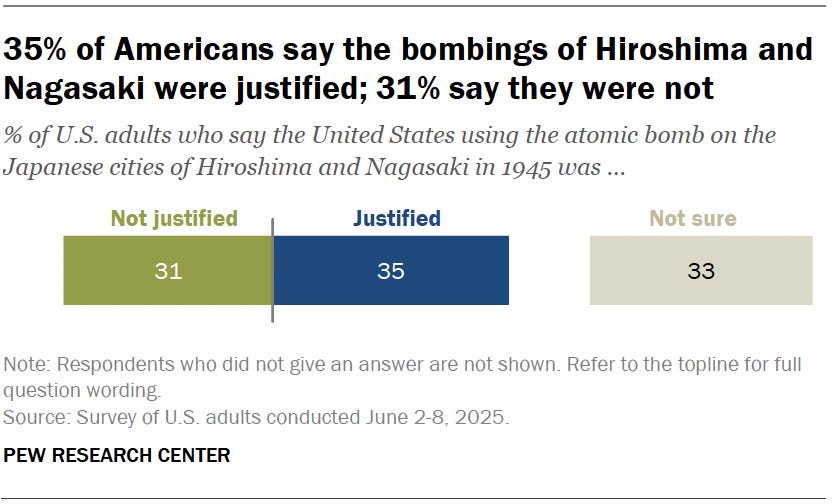
The further we get from those decisions, the more certain we become that they were wrong. In 1945, immediately after the bombings, Gallup found 85 percent of Americans approved. By 2015 that was 56 percent. Last summer, on the eightieth anniversary, Pew asked again: 35 percent said justified, 31 percent said not, and a third weren't sure. Among Americans under thirty, unjustified now beats justified, 44 to 27. No archive opened in those eighty years. What changed is distance. The men who made those calls get described as butchers by people who have never fully reckoned with the enemy the world was staring down. This is no indictment of the Japanese people. It is an indictment of the regime that ruled over them, and of the doctrine drilled into soldiers and civilians alike that produced a truly unique combatant in modern warfare.
July, 1945
By this time, our planes flew over the Japanese mainland unopposed. Our air superiority was total. Their cities were on fire, their navy was at the bottom of the ocean, and by any measure the war was over.
Yet Japan would not stop.
That was the fundamental problem, and it was not one we had an easy solution for. We were facing a foe who truly did not know how or when to quit, and nothing in modern warfare, certainly nothing in our American experience, had prepared us for what that meant.
To understand the fear, you have to understand what we already knew about the enemy.
The Rape of Nanking

I recount this part of the story with immense trepidation, because of just how brutal and nasty it is, and even because of how it affects our politics today.
December 1937 was when the Japanese army took the Chinese city of Nanking and spent roughly six weeks killing and raping on a fairly unimaginable scale. Some 300,000 people were murdered and tens of thousands of women were raped.
There is one particular detail that has always stuck with me. Japanese reporters wrote in the newspapers about two officers, Toshiaki Mukai and Tsuyoshi Noda, running a contest to see who could first kill a hundred people with a sword, often by cutting off their heads. The newspapers covered it the way you cover an Olympic medal count, printing running tallies over several days. When both men passed a hundred and nobody could say who had gotten there first, the papers reported that they simply raised the target to a hundred and fifty and kept going. Each was tried and executed after the war for his brutality.
The fact that these horrific acts ran in newspapers like patriotic propaganda tells you a lot about a country and their wartime psyche.
Never Surrender.
Then there was the way they fought, which was the part that kept so many American military planners perplexed. What I described on Peleliu was not an exception but a pattern. Japanese soldiers just did not surrender. Across the island campaigns, the ratio of Japanese killed to captured was so lopsided that American commanders really had no precedent for it.
At Attu, in the Aleutians in May 1943, a garrison of 2,600 yielded only 28 prisoners.
At Tarawa that November, 4,700 men yielded only 17.
At Iwo Jima, roughly 21,000 produced 216, and some of those only because they had been knocked unconscious.
At Saipan, a garrison of about 30,000 surrendered notably more than a thousand but only because of the heroic efforts of Guy Gabaldon, an American Soldier who spoke fluent Japanese and pleaded with survivors eventually saving hundreds.
Look at that compared to how conflicts ended in Europe. When the Axis position fell apart in North Africa, the Allies took over a quarter million German and Italian prisoners. At Stalingrad, the German Sixth Army gave up around 100,000 men. Surrendering when the battle is over was, and is, an accepted part of warfare. Germans, Italians, British, and French all did it, sometimes by the hundreds of thousands. Japanese troops did it by the handful.
We did it ourselves, and against this very enemy. On April 9, 1942, on the Bataan peninsula in the Philippines, roughly 76,000 American and Filipino troops laid down their arms, the largest army ever to surrender under American command.
What it got them was the Bataan Death March.
This was a roughly sixty-five mile trek up the peninsula in tropical heat, with most prisoner already sick and half-starved after months of siege. Guards beat them with rifle butts, bayoneted them, shot them, and in some cases beheaded them, for falling behind or for stepping out of line to reach water.
Somewhere between 500 and 650 Americans and several thousand Filipinos died on the march itself. Of the roughly 22,000 Americans taken prisoner on Bataan, only about 15,000 survived. The Japanese commander in charge of the camp was later shot for this crime.
You see, it is important to understand that they were treated that way precisely because they had surrendered. To their captors, a man who allowed himself to be taken alive had forfeited any claim to be treated as a human being. Those men were being punished for doing the thing every other army on earth considered normal.
Historian Max Hastings puts the gap in a single comparison: by August 1944, there were fewer than 2,000 Japanese in American prisoner-of-war camps, while German prisoners were arriving by the shipload.
This trait did not spring out of nowhere. It was beaten into them in their training. In 1941 the War Ministry issued the Senjinkun, the field code for every soldier, and when it came to capture the instruction was explicit: never live to experience the shame of being taken prisoner. They combined that with deceitful propaganda describing Americans as the type who would torture and rape them if they ever succumbed to that shame.
Unfortunately, civilians were told a lot of the same lies. I mentioned Saipan earlier. It has become notable for the cliffs now called Suicide Cliff and Banzai Cliff, where close to a thousand Japanese civilians killed themselves rather than be captured. American Marines watched as families waded into the sea to drown, and as parents threw their children off the rocks only to jump in after them.
It is that enemy mindset the top brass were planning around in 1945.
Fire, first.
The atom bomb we are all so familiar with was not the first attempt to get the Japanese to capitulate.
On the night of March 9 and into March 10, 1945, B-29s dropped incendiaries on a largely wooden part of Tokyo, and the resulting firestorm killed close to 100,000 people and displaced more than a million from their homes. It became the deadliest air raid in human history, and it killed more people than either atomic bomb. Over the following months the same campaign happened across dozens of Japanese cities, killing close to 300,000 civilians.
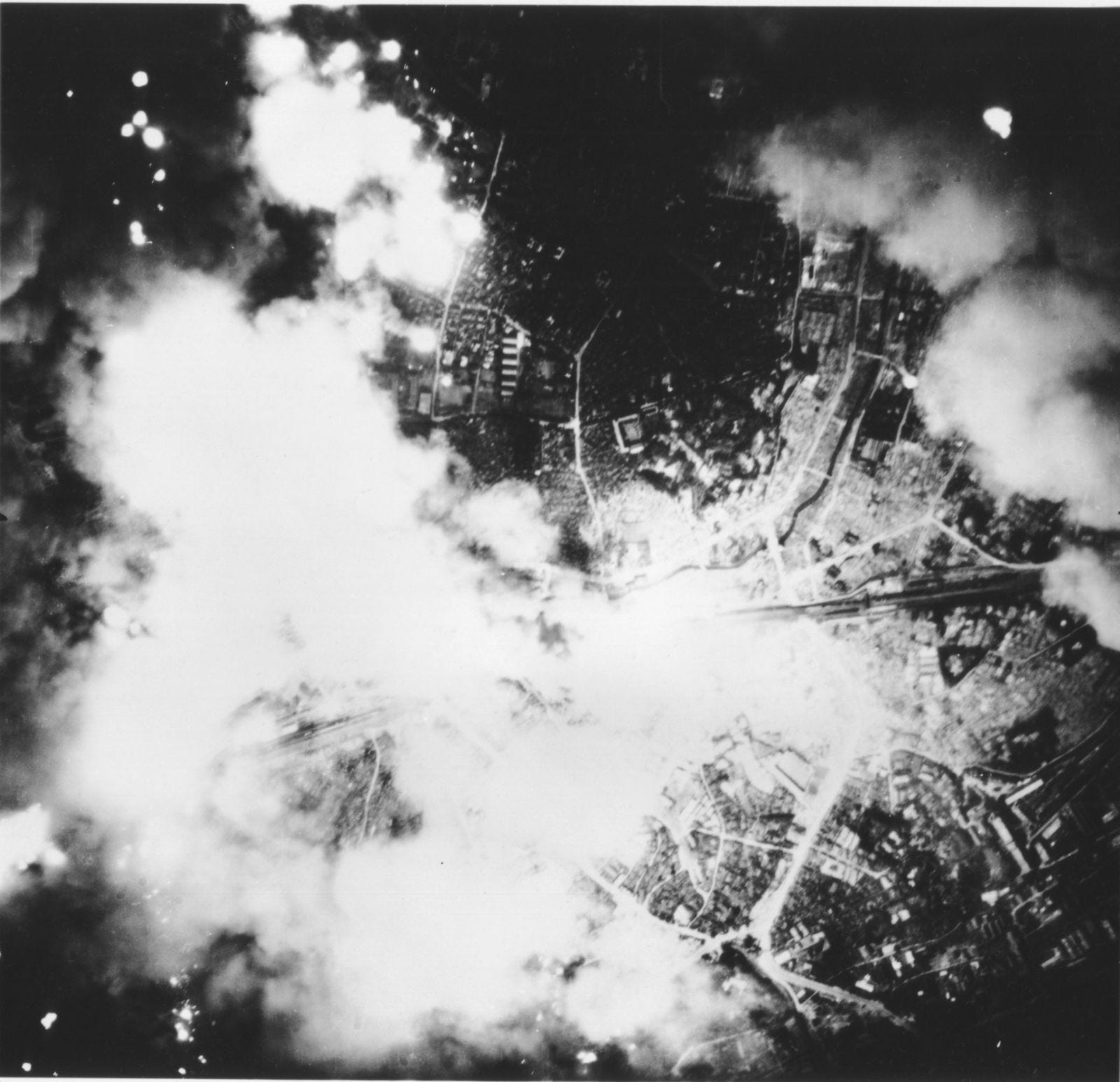
That was all before the atomic bomb, and yet still Japan did not surrender. It kept fighting.
That is when the generals began to fear the worst: a land invasion might become necessary. The question was what it would cost the American people. The uncertainty was so real that estimates ranged from 100,000 to over a million casualties.
Purple Hearts:
It was in response to this that the United States manufactured an astounding number of Purple Hearts. Roughly 1.5 million were struck for the war effort, with production peaking as we prepared for what seemed like the inevitable assault on the Japanese mainland.
Fortunately, the invasion never came, and that surplus stood at 495,000 medals.
Incredibly, medals struck for that invasion have now been pinned on the wounded of Korea, Vietnam, Iraq, and Afghanistan. A soldier decorated for his actions in Fallujah may be wearing a medal stamped for a battle his great-grandfather was supposed to die in. Historian D.M. Giangreco put it plainly in a 2010 email to Stars and Stripes: “Time and combat will continue to erode the WWII stock, but it’s anyone’s guess how long it will be before the last Purple Heart for the invasion of Japan is pinned on a young soldier’s chest.”
A Last Resort
What came instead of that invasion was a final effort to demonstrate American power and force a surrender, hopefully sparing a generation of American sons and the wholesale destruction of the Japanese people that a ground assault would have required.
That final step was the atomic bomb. Hiroshima on August 6 and Nagasaki on August 9, with the death toll estimated between 150,000-246,000.
It would be easy to say the plan worked. But even after this further display of power, the internal debate was far closer than you can comprehend. Japan’s inner war cabinet, a supreme council of six men, was still tied three to three. One group wanted to accept the Allied terms on the condition that they could keep their emperor. The other, led by the war minister and the two service chiefs, demanded more concessions from the United States:
keeping the emperor
the ability to run their own war crimes trials
self-policing of disarmament
little or no occupation
They believed a homeland battle would bleed Americans badly enough to get even better terms. Two atomic bombs had not changed their minds.
In an incredible twist of fate, the deadlock was broken by the emperor himself, with Hirohito stepping in to decide for surrender. It was an unimaginable move, as the emperor in those days rarely intervened despite holding supreme authority. His recorded message to the nation would be broadcast the next day.
But when I tell you they were committed to the continuation of this fight, the events of that evening only further prove my point. After the emperor broke the deadlock and recorded his message on the night of August 14, army officers attempted a coup to steal the recording and keep the surrender from ever being announced. They seized the palace grounds, murdered the general commanding the palace guard, forged orders in his name, and hunted through the buildings for the phonograph records. Heroic palace staff hid the discs and kept them out of rebel hands through the night, stifling the coup, whose leader later shot himself.
The following day, for the first time in their lives, the Japanese people heard the voice of their emperor on the radio. He did not use the word “surrender,” but he did tell his people that the enemy had begun to use “a new and most cruel bomb,” and he asked the nation to endure the unendurable.
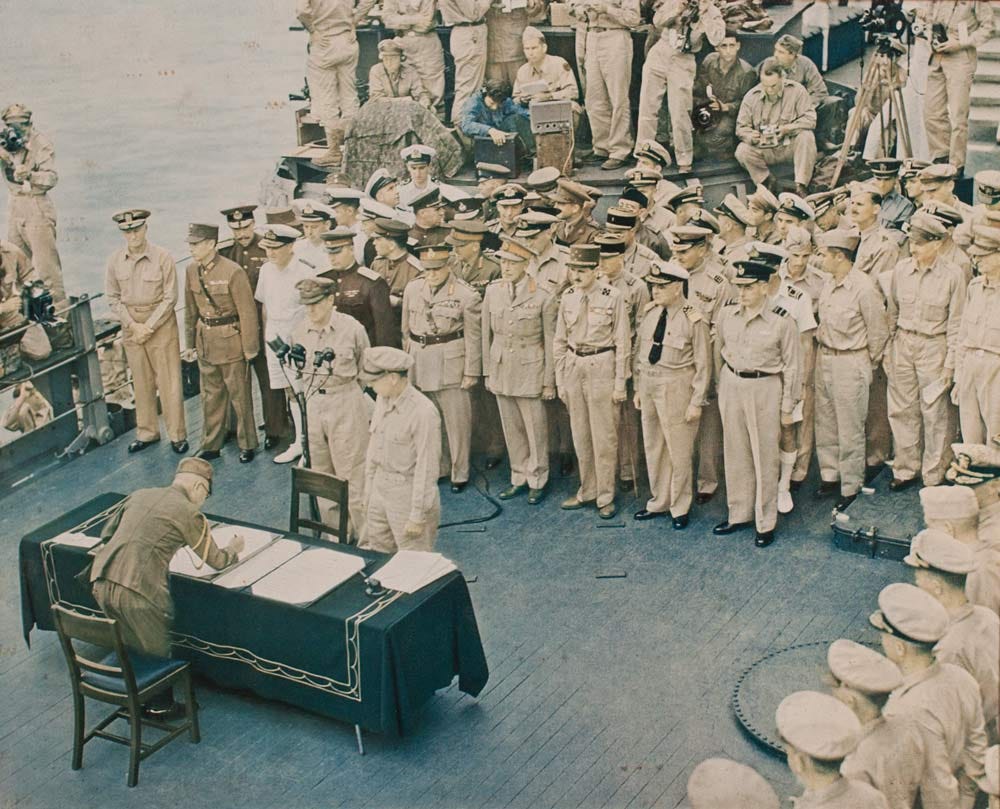
It was a little over two weeks later, aboard the USS Missouri, that Japanese officials officially signed the surrender.
Blood on my hands
Even the man who created this weapon struggled with what he had put into the world. Robert Oppenheimer, watching the detonation at Trinity, quoted the Bhagavad-Gita: “Now I am become Death, the destroyer of worlds.”
It was in late October that year when he sat with President Truman, reflecting on what they had all done to bring about the end of the war. “Mr. President, I feel I have blood on my hands.”
Interestingly, Truman had no patience for it. He dismissed Oppenheimer, “Blood on his hands, dammit, he hasn’t half as much blood on his hands as I have. You just don’t go around bellyaching about it.” He told Dean Acheson never to let that man in his office again, and months later referred to him in a letter as a “cry-baby scientist.”
You see, no one is arguing that the means were not brutal and the decisions difficult. What I hope I am demonstrating is just how necessary it all was. In fact, the hand-wringing in that exchange shows how hesitant the United States, and even the bomb’s own creator, were about what they ended up doing.
Which is why it is so helpful to take in the full picture of what these men were facing:
the brutality of what they had seen against the Chinese
the commitment to total war
the nearly unique psychology of never surrendering
the refusal to quit even after a firebombing campaign had burned most of their cities
a final refusal even after two atomic weapons
Now consider just one more man. Lieutenant Hiroo Onoda was sent to Lubang Island in the Philippines in 1944 and ordered to hold out. He did and was still holding out in 1974.
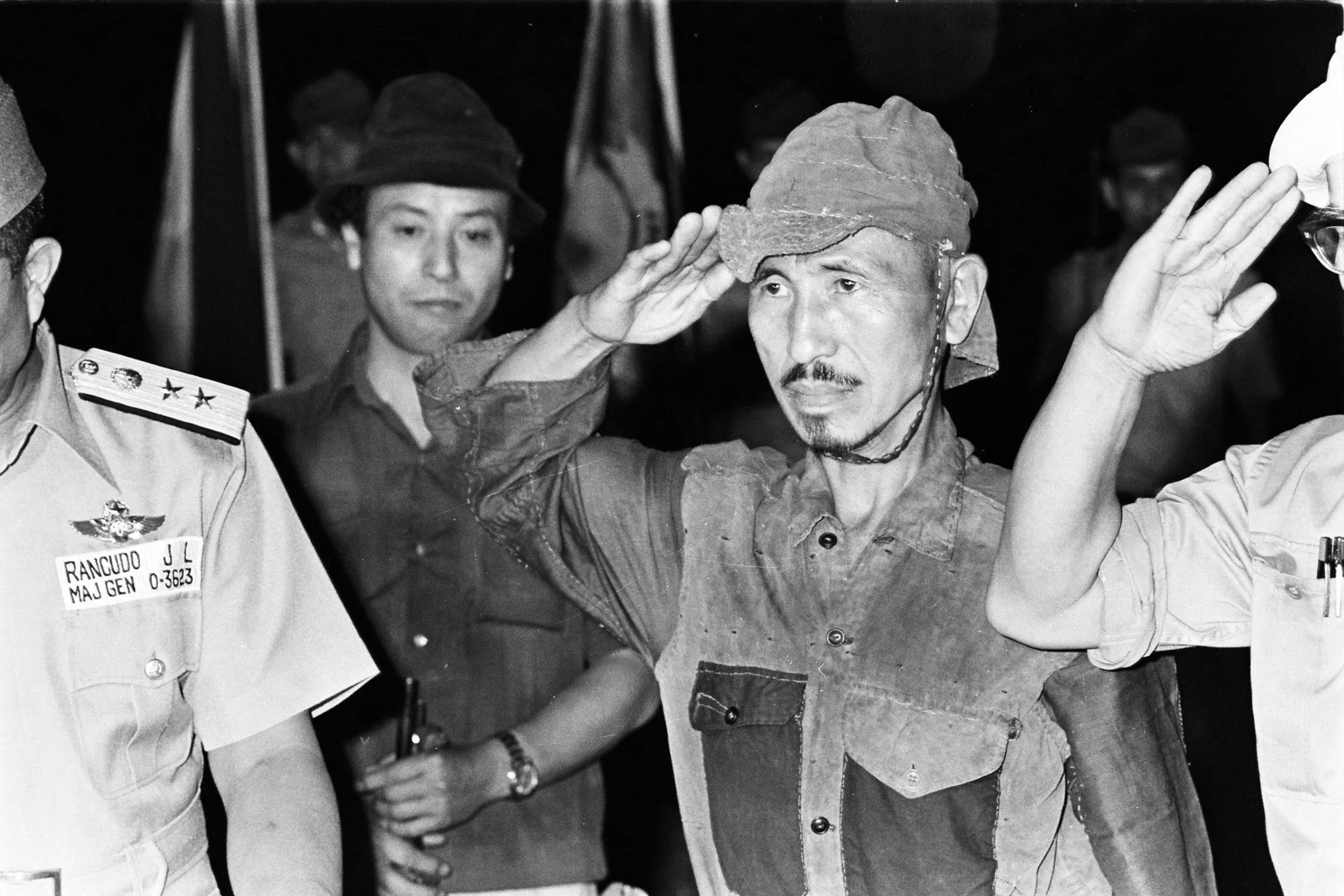
Twenty-nine years. He was declared dead in 1959. Search parties, leaflets, even his own family tried to coax his surrender but he thought it was all an American ploy.
He finally laid down his rifle in March 1974, and only because the Japanese government tracked down his old commanding officer and flew him to the island to order him to stand down. That is the mindset their training produced. A man who could not stop until someone with the right authority told him he could.
And now, today.
Our stockpile of Purple Hearts stands as a chilling reminder of how many of us, even those reading this article, may not have existed had an invasion been our course of action. How many young bloodlines would have ended on a Japanese beach?
Had our forefathers not developed the bomb. Had the emperor stayed silent. Had those rebellious officers found the recordings before dawn on the fifteenth of August. A generation of young men would’ve paid the final cost to finish the war in the Pacific.
It’s a good reminder that situations like these are always more complicated than we want to believe, and the historical context should produce in all of us a hesitancy about our certainty, and maybe a little gratitude that there were good men in positions of authority who did what they had to do to restore peace.
Preemptively responding to the pushback I may get on this article: for those inclined to dispute the good nature or the peaceful aims of our country in this conflict, I would encourage you to think a little deeper.
For multiple years after Hiroshima, the United States was the only nation on earth that possessed atomic weapons. We could have dictated further terms to anyone on earth, taken territory, demanded tribute, or settled scores with the Soviets, and there was not a country alive that could have stopped us.
We did none of it.
We deployed a weapon twice to end a war that Japan’s own leaders refused to end, and then we joined them in rebuilding the country we had just burned. We helped them form a government, sent food to get them through a famine, and less than a decade later handed the reins of their country back to them. They stand as our allies today.
Find another nation in history that held a civilization-altering weapon alone for years and declined to use that advantage to dominate the world. I’m proud to say America stands at the top of that list alone, and we can all be glad it was our leaders who got the chance to make that choice.
Recommended reading
If you want to go deeper on any of this, these three are where I would start.
PODCAST SERIES: Supernova in the East, Dan Carlin - Hardcore History
The Rising Sun: The Decline and Fall of the Japanese Empire, 1936-1945, John Toland
American Prometheus: The Triumph and Tragedy of J. Robert Oppenheimer, by Kai Bird and Martin J. Sherwin. The definitive life, and the source for the Oval Office exchange above.
The Rape of Nanking: The Forgotten Holocaust of World War II, by Iris Chang. The book that put Nanjing back in front of Western readers.
The Making of the Atomic Bomb, by Richard Rhodes. The whole arc, from the physics to the decision.
ABOUT THE AUTHOR:
Currently, I serve as the Executive Director of Them Before Us, advocating globally for the rights and well-being of children.
I am also the co-founder of All The Good, a leadership organization helping non-profits do all the good they are called to do.
I studied Cross-Cultural Ministry and Humanitarian and Disaster Leadership at Messiah and Wheaton. I read a lot and sleep less than I probably should.
My wife and I live in Charlotte, North Carolina with our 4 kids.

This is a terrific article, in both the current and historic use of the word. It is a grim reminder to us older folks and a needed instruction for younger folks. Thanks for writing it.
This is excellent, and I am grateful for you.